
Puppy's First Week at Home (8-9 weeks)
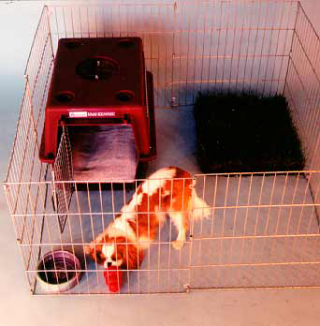
Start housetraining your pup the moment he comes home. It is important, and surprisingly easy, to train your puppy without him making a single toilet or chewing mistake. Each mistake will make training considerably more difficult. Puppies quickly establish toilet habits and even a single mistake heralds many more in the future. Also, punishing puppies for soiling the house or making chewing mistakes inadvertently teaches them to soil the house or chew on shoes while their owners are away (and therefore, cannot punish). Remember, good habits are just as hard to break as bad habits and so, housetrain your puppy from the outset.
Confinement is the secret to errorless housetraining — using a doggy den and a puppy playroom) to make sure your unsupervised puppy will not make any mistakes. The whole point of confining puppies while they are young is so that they will be able to have as much freedom as possible when they are older. Alternatively, if you let your new puppy roam free and form bad house-habits, you will no doubt confine him as an adult. Also, of course, make sure you teach your puppy to love his den and playroom.
With the proper use of a doggy den it is very easy to predict when your puppy will need to use the toilet. This means you can take your puppy to your chosen toilet location and know they will promptly pee or poop so that you may reward them extravagantly and play with them indoors, knowing they won’t have an accident. Additionally, you are in complete control of what objects they have access to in their confinement areas, so they may learn to chew only appropriate items. Hollow chewtoys stuffed with food will teach them what is appropriate to chew, and reward them for quietly enjoying some appropriate recreational chewing.
Regular, early confinement will help your puppy learn to enjoy spending time at home alone.
You need to ensure that an errorless housetraining and chewtoy-training program is instituted the very first day your puppy comes home. During the first week, puppies characteristically learn good or bad habits that set the precedent for weeks, months, and sometimes years to come. Never forget, good habits are just as hard to break as bad habits!
(For more information about your Puppy's First Week at Home, including videos, worksheets, and personalized email support, join Dr. Ian Dunbar's Top Dog Academy. Use this link to get your first month for free.)
The Very First Day Your Puppy Comes Home
Your canine newcomer is just itching to learn household manners. She wants to please, but she has to learn how. Before the young pup can be trusted to have full run of the house, somebody must teach the house rules. There's no point keeping house rules a secret. Somebody has to tell the pup. And that somebody is you. Otherwise, your puppy will let her imagination run wild in her quest for occupational therapy to pass the time of day. Without a firm grounding in canine domestic etiquette, your puppy will be left to improvise in her choice of toys and toilets. The pup will no doubt eliminate in closets and on carpets, and your couches and curtains will be viewed as mere playthings for destruction. Each mistake is a potential disaster, since it heralds many more to come. If your pup is allowed to make "mistakes," bad habits will quickly become the status quo, making it necessary to break bad habits before teaching good ones.
Begin by teaching your puppy good habits from the very first day she comes home. Your puppy's living quarters need to be designed so that housetraining and chewtoy-training are errorless.
Be absolutely certain that you fully understand the principles of long-term and short-term confinement before you bring your new puppy home. With a long-term and short-term confinement schedule, housetraining and chewtoy-training are easy, efficient, and errorless. During her first few weeks at home, regular confinement (with chewtoys stuffed with kibble) teaches the puppy to teach herself to chew chewtoys, to settle down calmly and quietly, and not to become a recreational barker. Moreover, short-term confinement allows you to predict when your puppy needs to relieve herself, so that you may take her to the right spot and reward her for eliminating.
From the moment you choose your puppy, there is some considerable urgency regarding socialization and training. There is no time to waste. Basically, an adult dog's temperament and behavior habits (both good and bad) are shaped during puppyhood — very early puppyhood. It is easy to make horrendous mistakes during your puppy’s first few weeks at home. Such mistakes usually have an indelible effect, influencing your pup's behavior and temperament for the rest of his life. This is not to say that unsocialized and untrained eight-week-old pups cannot be rehabilitated. They can, if you work quickly. But while it’s easy to prevent behavior and temperament problems, rehabilitation can be both difficult and time-consuming, and it is unlikely that your pup will ever become the adult dog he or she could have been.
Mistakes
If your pup is ever left unsupervised indoors he will most certainly chew household articles and soil your house. Although these teeny accidents do little damage in themselves, they set the precedent for your puppy's choice of toys and toilets for many months to come.
Any housesoiling or chewing mistake you allow your puppy to make is absolute silliness and absolute seriousness: silliness because you are creating lots of future headaches for yourself, and seriousness because millions of dogs are euthanized each year simply because their owners did not know how to housetrain or chewtoy-train them.
You should treat any puppy housesoiling or house-destruction mistake as a potential disaster, since it predicts numerous future mistakes from a dog with larger bladder and bowels and much more destructive jaws. Many owners begin to notice their puppy's destructiveness by the time he is four to five months old, when the pup is characteristically relegated outdoors. Destruction is the product of a puppy's boredom, lack of supervision, and a search for entertainment. Natural inquisitiveness prompts the lonely pup to dig, bark, and escape in his quest for some form of occupational therapy to pass the day in solitary confinement. Once the neighbors complain about the dog's incessant barking and periodic escapes, the dog is often further confined to a garage or basement. Usually though, this is only a temporary measure until the dog is surrendered to a local animal shelter to play the lotto of life. Fewer than 25 percent of surrendered dogs are adopted, of which about half are returned as soon as the new owners discover their adopted adolescent's annoying problems.
The above summarizes the fate of many dogs. Without a doubt, simple and predictable behavior problems are the number one terminal illness for domestic dogs. This is especially sad because all these simple problems could be prevented so easily. Housetraining and chewtoy-training are hardly rocket science. But you do need to know what to do. And you need to know what to do before you bring your puppy home. Make certain that your puppy does not develop life-threatening behavior problems.
If you already have a puppy and feel that you are behind, do not throw in the towel. You must acknowledge, however, that you are behind and that your puppy's socialization and education are now a dire emergency. Immediately do your best to catch up. Immediately, seek help from a pet dog trainer. To locate a Certified Pet Dog Trainer (CPDT) in your area contact the Association of Pet Dog Trainers.
Maybe take a week or two off of work to devote to your puppy. The younger your puppy, the easier and quicker it is to catch up on her developmental timetable and minimize losses. Every day you delay, however, makes it harder.
Want to raise the perfect puppy?
Learn more about puppy training with The Best Online Puppy Training Programs:
The Top Dog Academy. Learn how to deal with puppy biting, crate training, toilet training, socialization and more with videos, worksheets and podcasts about puppy training. When you join the Top Dog Academy you also get access to personalized email support so you can train your puppy yourself. Use this link to get your first month for free.
SIRIUS Puppy Training. Looking for more support? Get personalized, real-time, video dog training guidance from an expert SIRIUS Puppy Training instructor. Dr. Dunbar's SIRIUS Puppy & Dog Training classes revolutionized the world of pet dogs when they were first created. Now, our online small-group classes allow you to get the expert assistance you need from the comfort of your home.