













- Start out ahead by searching for a puppy that has been raised with errorless housetraining and chewtoy-training programs underway, that has been safely socialized with and handled by at least a hundred people and has been taught some basic manners.
- Prevent housesoiling, destructive chewing, excessive barking and separation anxiety by starting your puppy’s errorless housetraining, chewtoy-training, and alone-time-training programs the very first day he/she comes home.
- Breeders, Veterinarians and Pet Stores are the first point of contact with puppies and any successful puppy raising program depends on you. Please do your best to ensure that puppy owners contact trainers as early as possible to prevent them from going to shelters.
- Puppies must be safely socialized to people and taught to enjoy being hugged and handled (restrained and examined) before they are three months old, otherwise, during adolescence they will likely become wary and fearful and maybe aggressive towards people. Socialization is an ongoing process and must start very early and is on ongoing process.
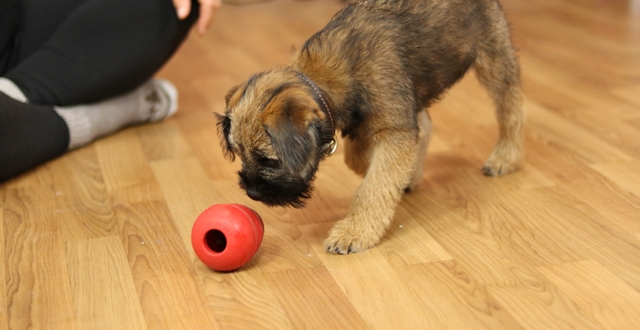
- Puppies need to be raised with housetraining, chewtoy-training and alone-time-training programs up and running from the outset in order to prevent housesoiling, destructive chewing, excessive barking and separation anxiety.
- Puppies benefit from early manners training — lure/reward training is as quick and easy as it is enjoyable.
For dogs that jump-up to greet owners and visitors at home or strangers in the street, a variety of dog training texts recommend the owner shout at the dog, squirt him in the face with water or lemon juice, swat him on the nose with a rolled-up newspaper, yank on the dog's leash and/or halter, hang the dog by his choke-collar, squeeze the dog's front paws, tread on his hind paws, knee him in the chest, or flip him over backwards. Surely this is all pretty crazy for a dog that's only trying to say hello. Confucius once said, "No need to use an axe to remove a fly from the forehead of a friend." Indeed, why not just train the dog to sit, or lie down, when greeting people?
Reasons Why
Even though few of us are fluent in the many dog languages, most of us can tell the difference between a friendly dog and an unfriendly one. The dog seems to get the message across with very little difficulty. It is as easy to sense the aura of a confident, relaxed and easygoing dog as it is to observe specific behaviors and body postures. Such dogs fairly exude warmth and friendliness — head held high with a big doggy laugh, gamboling gait and curved tail wagging the dog's rump. Similarly, one can literally feel the tension emanating from a dog that is not friendly — head lowered, ears flattened, piercing stare, teeth bared and growling, pilo-erection along the back, stiff-legged, and tail held high, straight, stiff and usually vibrating.
The dog is a social and inquisitive animal. He needs to do something, especially if left at home alone. What would you like your dog to do? Crosswords? Needlepoint? Watch soaps on the telly?

LURE/REWARD TRAINING
The science of lure/reward training is pure and simple —as simple, in fact, as 1–2–3–4:
1. Request
2. Lure,
3. Response
4. Reward.
For example: 1. Say, “Sit,” 2. Lure the dog to sit by moving a food lure upwards in front of the dog’s nose, so that 3. As the dog raises his head to follow the food, he compensates by lowering his rump to the ground and sits — the desired Response and so, 4. Reward the dog with a scratch behind his ear, by throwing Tennis Tug ball to retrieve, or simply just give him the food.
You should use the rewards that your dog enjoys most. If your dog loves Romaine lettuce, then by all means, use it in training.
All-or-none reward training is the quintessence — the sine qua non — of successful adult dog training. All-or-none reward training techniques are easy, simple and extremely effective. The techniques have similarities to clicker training in that no commands are given and the dogs are neither lured nor prompted. However, all-or-none reward training is much quicker than clicker training since shaping is unnecessary. Within just a few minutes, without giving a single instruction, your dog will learn to pay attention, not to touch forbidden food and objects, sit stay and to walk calmly on leash. And once all-or-none reward training techniques give you back your dog’s attention, you can go back to using the lightning-fast, lure/reward training techniques that you used with your puppy.
Within the allotted one-minute time period, the dog must take an article from the handler and follow the handler’s directions, so as to drop the article as close as possible to a $100 bill, which is taped on the floor approximately 30 feet away. The article (usually a squeaky and/or soft toy) is supplied by the judge and is the same for each dog in any competition but is different for each competition. While giving directions to the dog, the handler must remain seated at all times. The handler is disqualified if the judge can see daylight between the handler’s butt and the chair. Once the dog has placed the object to the handler’s satisfaction, the handler raises an arm and shouts, “Mark!” and the distance is measured.
Also in Week 4, owners begin learning how to translate their verbal commands using the hand signals that their pups have already learned. With practice, the pups will soon be following verbal commands even if they can’t see their owners. We spend more time on Stays, focusing on trouble-shooting and proofing.
Download all of SIRIUS Berkeley Puppy 1 Here
|