



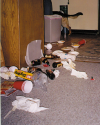



Behavior Problems

Why do dogs misbehave? Or, perhaps we should ask, do dogs misbehave? Certainly, dogs are dogs, and unless given appropriate guidance, puppies will grow up to behave like dogs. However, most behavior problems that irritate owners are, in fact, perfectly normal, natural and necessary canine behaviors.
From a dog’s point of view, it is as normal to bark, chew, dig and urine-mark as it is to wag a tail or bury a bone. Moreover, just as it is a physiological necessity for dogs to urinate and defecate, it is a psychological necessity for dogs occasionally to bark, howl, chew, sniff, dig, run, jump, chase and play. Obviously, dogs have an inherent need, desire, drive, or motivation to act like dogs.
So, the dog's behaviors per se are quite normal and utterly necessary, rather it is their manner of expression that is inappropriate. Well, here again, dogs might disagree. I am lucky to be fluent in several canine languages — including Labradorian, Malamutian and Yorkiese — and Labradors have convinced me that they consider it perfectly appropriate to jump-up, knock over folding chairs, pounce in mud puddles, and socialize with a fallen leaf, just as Malamutes and Yorkies have taught me that it is entirely acceptable and even expected to howl in the middle of the night and to pee on carpets (so as not to get one’s feet wet). So, dogs consider their behavior to be both appropriate and acceptable, rather it is owners who consider some dog behaviors to be inappropriate and unacceptable.
Since people have invited dogs into their human homes, and since people (and not dogs) consider some dog behaviors to be inappropriate and unacceptable, then people should do their best to understand and respect dogs as dogs and to try and understand their point of view, yet to teach them how to express their natural dogginess in a manner that does not frustrate or offend their human housemates.
It is unrealistic to expect all dogs to grow up automatically to behave like Lassie. (“Lassie” was in fact several highly trained dogs.) If owners understandably have rules and regulations as to how they would like their dog to behave, they should not keep these rules a secret from the dog. Otherwise, the poor dog will predictably break rules that he didn't even know existed and no doubt, be punished for these inevitable “transgressions.”
Owners must teach dogs how to express their basic doggy nature in a manner that is both acceptable and appropriate within the domestic setting. The owner must at least meet the dog halfway and establish a mutually agreeable arrangement vis a vis the dog's conduct in urban, suburban and rural neighborhoods. Otherwise, the dog will be left to improvise in his endless quest for some kind of occupational therapy to pass the time of day and most likely, the owners will take considerable exception to the dog's selection of activities and entertainment.
Specifically, owners should teach their dogs what to chew, where to eliminate, where to dig, when and for how long to bark, how to enjoy spending time at home alone, when to pull on leash, when and how to be hyperdog, and especially how to greet, socialize and play with other dogs and people.

AttachmentSize
Housetraining.pdf1.46 MB
Destructive Chewing.pdf1.44 MB
Excessive Barking.pdf1.57 MB
Digging Problems.pdf1.3 MB
Home Alone.pdf1.61 MB
Fear of People.pdf837.96 KB
Fighting with Dogs.pdf991.26 KB
HyperDog.pdf932.61 KB
Walking On Leash.pdf896.78 KB
 

Articles in this Chapter:

HOUSESOILING

Housesoiling is a spatial problem. Your puppydog has been allowed to eliminate in the wrong place. Housesoiling quickly becomes a bad habit because dogs develop strong location, substrate, and olfactory preferences for their improvised indoor toilet areas. To housetrain your puppydog: first, prevent any more mistakes; and second, teach your puppydog where you would like him to eliminate.

Prevent Mistakes

Mistakes are a disaster since they set a bad precedent and create bad habits, which can be hard to break. Consequently, you must prevent mistakes at all cost. Whenever you are not at home, leave your dog in a long-term confinement area, such as a single room indoors with easy-to-clean floors (bathroom, kitchen, or utility room)—this will be your puppydog’s playroom.


DESTRUCTIVE CHEWING

Chewing is essential for maintaining the health of your dog's teeth, jaws, and gums. Puppies especially have a strong need to chew to relieve the irritation and inflammation of teething. Dogs chew to relieve anxiety and boredom, as well as for entertainment. Your dog’s jaws are his tools for carrying objects and for investigating his surroundings. Essentially, a dog’s approach to all items in his environment is “Can I chew it?”


EXCESSIVE BARKING

Some dogs get extremely worked up when visitors ring the doorbell, or when dogs walk by the house. Some spaniels and terriers bark at the drop of a hat. And our good friend Larry Labrador will bark whenever a leaf falls from a tree three blocks away. Barking is as characteristically doggy as wagging a tail or burying a bone. It would be inane and inhumane to try to stop your dog from barking altogether: "You’ll never bark in this town again!" After all, some barking is extremely useful. My dogs are much more efficient than the doorbell and much more convincing than a burglar alarm. The goal then, is to teach dogs normally to be calm and quiet but to sound the alarm when intruders enter your property.


DIGGING

Dogs dig to bury bones, and later to dig them up again. Dogs dig cooling hollows in the summer, and warming pits in the winter. Dogs dig after eavesdropping on private ultrasonic conversations of subterranean critters. Bitches dig dens when they are pregnant. Dogs dig out of boredom, and dogs dig to escape. But by and large, most dogs dig for the sheer fun of it.

Dogs Don’t See Your Problem


SEPARATION ANXIETY

Your new puppydog needs lots of attention (companionship, education, and play), but also to be taught how to entertain himself appropriately and how to thoroughly enjoy his time when left at home alone. Otherwise, a social vacuum can be a very lonely place.


FEARFULNESS

Socializing a puppy to people is the easiest and most enjoyable aspect of raising a dog. On a regular and ongoing basis, puppies need to meet, play with, and be handled and trained by a wide variety of people, especially including strangers, men, and children.

Narrow Window of Opportunity


FIGHTING

Many people have unrealistic expectations about dog-dog social behavior. Dogs are expected to behave perfectly and get along with all other dogs, even though people have difficulty being universally accepting and friendly. However, although people may often disagree, argue, and sometimes resort to pushing and shoving, very few people inflict severe injuries. When tempers flare, extreme physical aggression is strongly inhibited. Really, dogs are not that much different.

Most dogs have frequent disagreements and arguments, and on occasions resort to scrapping noisily, but only extremely rarely does one dog severely harm another. Whereas it is unrealistic to expect dogs never to squabble, it is perfectly realistic to raise and train dogs to never hurt each other when fighting.


HYPERDOG!

Puppies are naturally noisy and hyperactive. Puppies are exuberant when greeting, playing, and when expressing friendliness and appeasement. However, adult dogs are noisy and hyperactive because they are untrained and have unintentionally been encouraged to act that way. For example, eagerly jumping puppies are petted by people, who later get angry when the dog jumps up as an adult. The dog's only crime? It grew!


PULLING ON LEASH

By and large, leash-pulling masks the real problem: without a leash you would probably be without a dog. It is indeed a sobering thought to think that most dogs prefer to forge ahead to sniff the grass or other dogs' rear ends than to walk by their owner's side.
There are some dogs who simply don't want to walk beside owners who keeping yanking the leash. However, regardless of why your dog pulls, all dogs need to be trained to walk nicely on leash. If not, they are unlikely to be walked at all.
Trying to teach a dog to heel using leash prompts and corrections requires a lot of skill and time. And even then, all you have is a well-behaved dog on-leash. Let him off-leash and he's history; you cannot safely take him for off-leash rambles, and you still cannot control him around the house, where he is off-leash all the time.