
HyperDog!
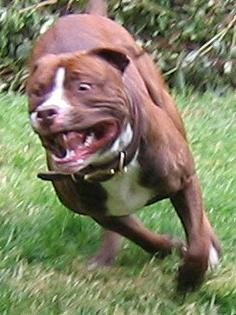
Puppies are naturally noisy and hyperactive. Puppies are exuberant when greeting, playing, and when expressing friendliness and appeasement. However, adult dogs are noisy and hyperactive because they are untrained and have unintentionally been encouraged to act that way. For example, eagerly jumping puppies are petted by people, who later get angry when the dog jumps up as an adult. The dog's only crime? It grew!
Sadly, adult dogs receive considerable abuse for expressing their enthusiasm and exuberance. For example, "The Trainers from the Dark Side" recommend teaching a dog not to jump up by shouting at the dog; squirting him in the face with water or lemon juice; swatting him on the nose with a rolled-up newspaper; yanking on the dog's leash; hanging the dog by his choke-collar; squeezing the dog's front paws; treading on his hind paws; kneeing the dog in the chest; or flipping the dog over backwards. Surely these methods are a bit cruel for a dog that's just trying to say hello. Indeed, in the words of Confucius, "There is no need to use an axe to remove a fly from the forehead of a friend." Why not just teach dogs to sit when greeting people?
Be smart. Be kind. Teach your puppy (or adult dog) to settle down and shush when requested and how to greet people in a mannerly fashion. Both dog noise and exuberance may be controlled and channeled into appropriate outlets.
Sit and Settle Down
Lure-reward train your puppy or dog to come, sit, and lie down. Simple instructions such as "Sit" and "Lie down" are extremely effective solutions for nearly all doggy activity problems. Rather than telling the pup "No, no, no!" and "NO!" for everything she does that annoys you, simply ask her to lie down, and then praise and reward her for doing so. If she lies down obediently, she cannot run around the living room, chase her tail, chase the cat, hump the cat, jump on the furniture, jump up and down in the car, run out the front door, or chase and jump on children. Lying down and most behavior problems are mutually exclusive; your dog cannot lie down and misbehave at the same time. Take the initiative and direct your puppy's behavior by teaching her to lie down on request.
Rather than feeding your puppy from a bowl, weigh out his kibble in the morning and use individual pieces as lures and rewards during oodles of five-second training interludes throughout the day. Practice in every room of the house, in the car (while stationary), and on walks. Pause every 25 yards and instruct your puppy to perform a series of body positions: for example, sit-down-sit-stand-down-stand. Within just a couple of days you'll have a totally different dog.
Simple reward training methods work wonders with out-of-control adolescent and adult dogs. Hold a piece of kibble in your hand but don't give it to your dog. Stand perfectly still and give no instructions; simply watch to see what your dog does. Characteristically, the dog will run through his entire behavior repertoire. Your dog will wiggle, waggle, circle, twirl, jump-up, lick, paw, back-up, and bark...but eventually he will sit or lie down. Praise him and offer the piece of kibble as soon as he sits (or lies down—your choice). Then take a gigantic step (to reactivate Rover), and stand still with another piece of kibble in your hand. Repeat the above sequence until Rover sits immediately after you take each step and then begin to progressively increase the delay before offering the kibble. Maybe count out the seconds in "good dogs"—"Good dog one, good dog two, good dog three, etc." If Rover breaks his sit while you are counting, simple turn your back on him, take a three-second timeout, and repeat the sequence again. In no time at all you will be able to count out 20 "good dogs" as Rover sits and stays calmly, looking up at you expectantly.
Move from room to room repeating this exercise. When walking Rover, stand still every 25 yards and wait for him to sit, then praise him and continue the walk. After handfeeding your dog just one meal in this fashion indoors and on one long walk with sits every 25-yards, you'll have a calmer and much more attentive dog.
Jumping Up
Jumping up deserves a special mention because it is the cause of so much frustration and abuse. Right from the outset, teach your puppy to sit when greeting people. Sitting is the obvious theoretical solution because a dog cannot sit and jump up at the same time. However, it may initially be difficult to teach your dog to sit when greeting people because he is so excited that he doesn't hear what you say. Consequently, you will need to troubleshoot his training.
First practice sits (as described above) in locations where your dog normally greets people, e.g., on-leash outdoors, and especially indoors by the front door. Then invite over ten friends for a dog training party. Today your dog's dinner will be handfed by guests at the front door and by friends on a walk. After eventually getting your dog to sit to greet the first guest, praise your dog and have the guest offer a piece of kibble. Then ask the guest to leave and ring the doorbell again. In fact, repeat front-door greetings until your dog greets the first guest in a mannerly fashion three times in a row. Then repeat the process with the other nine guests. In one training party you will probably practice over a hundred front-door greetings. Then ask your all your guests to leave one at a time and walk round the block. Put your dog on leash and walk around the block in the opposite direction. As you approach each person, instruct your dog to sit. Praise him when he does so and have the person offer a couple of pieces of kibble. After five laps, you will have practiced 50 sidewalk greetings. Now your dog will be ready to sit to greet bona fide guests at home and strangers on the street.
Put Doggy Enthusiasm and Activity on Cue
To be fair to your dog, make sure that she has ample opportunity to let off steam in an acceptable fashion. Sign up for flyball and agility classes. Play fetch with tennis balls and Frisbees and do yo-yo recalls (back and forth between two people) in the park. Formalize "crazy time"—train your dog to jump for bubbles, or play "tag" and chase your dog around the house. And maybe train your dog that it is acceptable to jump up on cue—to give you a welcome-home hug.
To learn more, read Doctor Dunbar's Good Little Dog Book. To locate puppy, adolescent, flyball, and agility classes in your area, contact the Association of Pet Dog Trainers at www.apdt.com .
 PDF (182.29 KB)