
Dog Communication
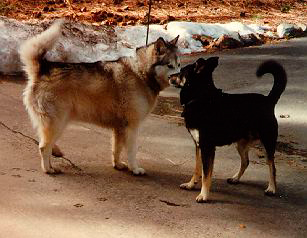
“In man, social intercourse has centered mainly on the process of absorbing fluid into the organism, but in the domestic dog and to a lesser extent among all wild canine species, the act charged with most social significance is the excretion of fluid. For man the pub, the estaminet, the Biergarten, but for the dog the tree trunk, the lintel of door or gate, and above all the lamppost, form the focal points of community life. For a man, the flavors of alcoholic drinks, but for a dog the infinitely variegated smells of urine are the most potent stimuli for the gregarious impulse.”
From The Lamppost, A Study of the Social Life of the Domestic Dog by Sirius (quoted in Sirius by Olaf Stapledon)
Humans communicate largely by the spoken and written word. (Hence this book.) Dogs, however, employ several different “languages”
Body language — comprising a broad repertoire of facial expressions and body postures such as, play bows, butt-swings, submissive grins, pilo-erection, ear dips and tail wags
Vocal communication — via a wide variety of barks plus all sorts of whimpers, whines, howls and growls
Olfactory communication — by investigating muzzles, ear glands, tail glands, vaginal and anal sac secretions and particularly, from sniffing urine and fecal deposits of other dogs. Dogs may discern an enormous amount of social information using their well developed sense of smell
Body Language
Even though few of us are fluent in the many dog languages, most of us can tell the difference between a friendly dog and an unfriendly one. The dog seems to get the message across with very little difficulty. It is as easy to sense the aura of a confident, relaxed and easygoing dog as it is to observe specific behaviors and body postures. Such dogs fairly exude warmth and friendliness: Head held high with a big doggy laugh, gamboling gait, with a relaxed, curved tail wagging the dog's rump. Similarly one can literally feel the tension emanating from a dog which is not friendly: Head lowered, ears flattened, piercing stare, teeth bared, growling, piloerection along the back, stiff-legged, and tail held high, straight, stiff and usually vibrating.
Similarly, it is easy for most people to distinguish between high-ranking and low-ranking dogs. Characteristically a high-ranking dog walks with a confident and purposeful gait, with head and tail held high, large eyes and raised ears, whereas a low-ranking slinks along in a fawning, obsequious gait, with lowered head, drawn back lips and protruding or licking tongue, narrow blinking eyes, lowered or flattened ears, raised paw and tail tucked between the legs. In extreme submission the dog may roll over and urinate.
It is hard to live with a dog for even a few days without learning a wide vocabulary of his body language. Most owners have a fairly firm grounding on how a dog acts when he is happy, confident, friendly, deferential, fearful, or aggressive. In fact, most dog owners have successfully compiled a comprehensive and descriptive doggy dictionary of body language covering much of the dog's behavior repertoire.
Vocalizations
The most misunderstood canine cues are vocalizations. Barking and especially growling are nearly always interpreted as threats, and on occasions, they are. But often they aren't. Barking, by its very nature is thought to be the ultimate vacillatory cue, expressed when the dog experiences conflict between two courses of action. For example, barking means: "I want to play... but I daren't," "I like you... but I'm not sure," or "Come here... but keep your distance." Once the dog makes up his mind what he wants to do, he generally does it, whereupon ihe has neither the time nor the inclination to bark.
Growling is more commonly used as a threat. Even so, feeling uneasy in a given situation is by far the most common reason for a dog to growl. Alternatively, growling and maybe soft biting/mouthing may be used as solicitations to play. Growling can be particularly worrying to owners, because often there are no discernible differences between threat-growls, insecure-growls and the dog's vast repertoire of play-growls.
What if you have a lot of difficulty stopping the dog from growling? Are we dealing with a dreaded dominant delinquent dog? — An aggressive cur? — An alpha leader of the pack? Most likely not. Characteristically, growly and blustery dogs are middle-ranking males, who have limited experience and are insecure of there social standing and so, usually resort to bluff and protracted threats. Often the dog may growl incessantly to add major emphasis to a minor point. Most overtly aggressive dogs are all bark and no bite. Indeed, a true top dog is a rather cool and relaxed customer, who very rarely resorts to threats of any kind, let alone lengthy blustery bluffs. Instead the threat is subtle and the follow up is immediate, short and sharp.
Often, “atmosphere cues” provide the only clue to correctly interpret the dog's intentions. Atmosphere cues may range from quite subtle movements (e.g., paw-raising) to gross body gestures (e.g., playbows and prances), which signal a change in the meaning of everything that follows. For example, raising a paw signals that subsequent chasing, growling and biting are all meant in play. Dogs excel in reading contextual cues; most people do not.
Olfactory Communication
Many dog owners have realized, dogs urinate far more frequently than is required by physiological need. Indeed, urinary scent marking serves many important functions, including territorial demarcation, sexual attraction, individual recognition and advertisement of puppy license.
Puppy License To Misbehave
Testosterone is the hormone which makes male urine smell male. Thus, the “maleness” of a dog's urine depends on level of testosterone in the body. In most mammals, adults have much higher testosterone levels than youngsters. This is not true for dogs though. Plasma testosterone levels start to rise by the time the male pup reaches four to five months old, whereafter testosterone levels reach a maximum at ten months of age and then fall to adult male levels by eighteen months of age. At the ten-month peak, testosterone levels in adolescent male dogs may be as much as five to seven times greater than adult levels.
Urine odor, therefore, betrays the age of young male dogs. The odor of puppy urine is quite distinct. The puppy's size, shape, sound, color, behavior and especially, his smell, all advertise the youngster's age. A rollover with a leaky urethra is a means for the pup to display his puppy license to older and/or higher ranking individuals: "Yo! Sniff this urine. See, I'm just a young puppy and don't know any better. Please don't harm me. I didn't mean to jump on your tail and bite your ears. He! He! He!" And sure enough, most socialized adult dogs are quite tolerant and lenient towards young pupskis. However... once testosterone levels start to rise, the male puppy's license to misbehave is rudely canceled. In fact, by ten months of age, adolescent male urine smells sooper-dooper, ultra-mega-hyper-male, informing all adult dogs: "Why lookyhere. This young urinater must be a developing male adolescent — a potential thorn in the side of social harmony. Let's educate the young fellow right now, while we still can." And sure enough, most adult dogs (especially males) start to harass developing male pups to put them in their place before they become a significant challenge on the social scene.
Territorial Marking?
The concept of territoriality incorporates the notions of marking as well as defence. In wolf packs, a greater concentration of male urine marks appear to be distributed along the peripheral buffer zone of the pack's territory compared with the core of the territory.
Perimeter marking by males is similarly prominent with domestic dogs. But, since most domestic dogs are confined to artificial “territories” by walls and fences, and since male dogs tend to urinate against vertical objects, one would expect the majority of urine marking to occur along the perimeter. Surprisingly though, perimeter marking was not observed in an observational study of free-ranging suburban domestic dogs, i.e., dogs which silly owners allowed to roam the neighborhood at different times of the day and night. Instead, free-roaming dogs regularly and heavily marked a number of often-used radial routes, which lead away from and back to their individual homes. Thus, most marking occurred close to home.
Free-roaming dogs did not actively protect the central area of their home range from other free-roaming dogs, nor did urinary scent marking appear to be effective in repelling other dogs, which freely entered and marked inhabited areas, sometimes when the resident was present. Free roaming domestic dogs do not appear to be in the least bit territorial and in fact, some dogs welcome visitors.
Dogs can distinguished between urine marks from different individuals and male dogs sniff and urinate more frequently in response to urine marks from unfamiliar males, compared with urine from familiar males and compared with their own urine. Also, a dog’s response to unfamiliar urine decreases with repeated exposure, as if “strange-male” urine progressively loses its strangeness. Rather than being an agonistic display of territorial defense, urinary scent marking by domestic dogs appears to be a means to make a strange environment smell like home, by masking the unfamiliar odors with individual urine. Urine marking appears to be the canine equivalent of personalizing a new home with furnishings and possessions.
Urinary scent marking is not the prerogative of male dogs. On the contrary, many bitches urine mark and also, many bitches will raise a leg when doing so. However, the female manner of raising a hind leg usually differs from the characteristic male leg lift posture. Male dogs stand with body weight forwards while a hind leg is abducted at the hip joint and the stifle swings out and upwards to lie above the backbone, so that urine may be jetted laterally towards some vertical object, which was in dire need of marking. Bitches, on the other hand, normally raise a hind paw which is brought forwards underneath the body, usually while the bitch is partially squatting. Often her rear end may be swiveled to one side to direct the urine.
Basically, dog urine is the canine equivalent of e-mail. P-mail if you like. Each urine mark contains its own message displayed on a communal message board. “Spot was here!” “So was Rex!” “Me too! Little Twerpie here.” “Hi! My name’s Butch and I’m ten months old.” “Well, my name’s Roger and I’ve been neutered.” “Shame! This is Trixie and I’m just hot to trot!” “Spot was here!” “Me too!” “Me too!” “Me too!” “And me. It’s Twerpie again!”