
Dr. Dunbar has always been one of the best at explaining dog training from the dog’s point of view, and in this video he highlights many of the most common mistakes humans make when trying to train their dogs.
Science-Based Dog Training (with Feeling): How Dog Training Transcends Learning Theory
Dr. Ian Dunbar | Thu, 09/23/2010 - 08:06
I have spent the past few years puzzling over why dog training is no longer working that well. Today there is much more management and less reliability than 10-plus years ago. Far too many dogs develop behavior, temperament and training problems and so are surrendered to shelters in a day and age where we have more knowledge than ever.
There is so much that we used to do in the 80s and 90s that we are no longer doing. Consequently, nowadays, far more dogs are fearful of people, reactive to other dogs and unreliable off-leash. Puppy classes are seldom taught off-leash and so, adolescent classes are seldom off-leash and so, as soon as dogs reach adolescence, socialization grinds to a halt and aggression problems appear. We must go back to training off–leash to ensure that socialization continues and that owners are taught off-leash verbal control independent of training aids.
When training doesn’t work that well, people will search for alternative methods, often with the (usually false) assumption that aversive treatment is better for resolving behavior problems and producing greater reliability than a reward–based program.
Indeed, I think that the relative ineffectiveness and time-commitment of many present-day reward-based programs are the major reasons we’ve seen a resurgence in aversive training techniques. We must go back to the successful off/leash lure/reward heyday of the 90s. Reward-training programs work brilliantly when conducted correctly. Effective training is best done off-leash from the outset with all training tools, especially, food, collars and leashes, phased out as soon as owners acquire off-leash verbal control over their dogs.
My new seminar series will focus on what I consider to be the most pressing and crucial concerns in pet dog training and of course, their solutions, including:
How easy it is for breeders to housetrain, chewtoy-train, obedience train and safely socialize puppies before they are eight weeks old (when the Critical Period of Socialization is already nearly two thirds over). If they do so they are raising house-ready companion dogs, rather than uneducated and un-socialized livestock.
Owners must realize that when they choose a puppy at eight-weeks of age, they may pick a well-behaved, well-mannered and well-socialized pup, or they may chose a pup that’s so severely under-socialized and behaviorally retarded that its temperament will never be what it could have been.
Teaching puppy classes that are off-leash (for 55 minutes in the hour) is as easy as it is enjoyable and has numerous time-sensitive developmental benefits — the puppies can acquire bite inhibition by socializing with people and other dogs and the owners can learn off-leash verbal control from the outset.
It is essential to resolve bullying and fearfulness during the very first week of puppy classes. These problems will become progressively harder to resolve as each week goes by.
Raising puppies to be people-friendly is as blindingly simple as it is excruciatingly enjoyable. There is absolutely no excuse for failure.
Raising puppies to be dog-friendly is a whole lot trickier. Basically we are not doing one tenth of the training, one hundredth of the socialization and one thousandth of the classical conditioning to prepare dogs to successfully navigate adolescence. Unfortunately, few owners think of classically conditioning a happy-go-lucky sociable puppy even though the utterly predictable problems of adolescence are just a couple of weeks or months away.
How to properly introduce and quickly phase out any training tool, so that it does not become a permanent crutch in training, causing response-reliability to become tool-dependent. This principle applies to any tool in training from leashes to halters to collars (metal or shock). Otherwise, most training tools will quickly become permanent management tools.
The 3 Stages and the 1-2-3-4 Basic Training Sequence of Lure/Reward Training — the absolutely quickest and easiest way to teach off-leash verbal control.
How to phase out food lures within 6-12 trials as dogs quickly learn hand-signals. If food lures and food pouches are not phased out, response-reliability is likely to become dependent upon the person having food in their hand or food pouch.
How to phase out the necessity of hand-signals. Hand-signals will continue to be used of course, however we must check that dogs will respond reliably to verbal commands only without the continued need of lures, hand-signals or body movement cues. Try this from my Sit Test. Have a friend hold your dog on leash two yards behind you. Without looking at your dog, ask, “Rover, Sit”. If the dog sits, your friend will praise the dog and so, if you hear no praise, you know that your dog didn’t sit. Well, if he doesn’t sit when your back is turned and he’s just two yards away, what would make you think that he would sit when his back is turned and he’s forty yards away chasing a skateboarder? All complex in-the-field training problems may be demonstrated indoors.
How to replace food rewards with life rewards by integrating numerous short training interludes into walks and play and by yo-yoing the Big 7 Behavior Problems with desired behaviors, i.e., by putting distractions and problem behaviors on cue, so that they may be used as rewards in training.
Deconstructing laboratory-generated learning theory (created from experiments wherein computers trained rats and pigeons) and reconstructing a simplified and more effective, new learning theory that works in practice (when people train dogs). So many aspects of learning theory simply don’t work in the real world when people are the trainers. Obviously, I cannot blog my entire three-day seminar but here are a bunch of choice points.
Punishment–training which is so effective in the laboratory, often fails in real life because people are inconsistent and so, the dog learns those occasions when he cannot be punished, i.e., when left at home alone, when off-leash, or when the owner is distracted.
Most reinforcement schedules are relatively ineffective at maintaining and especially improving behavior. The human brain cannot compute the variable schedules and train a dog at the same time and the fixed schedules cause decreases in quality of performance following fixed interval rewards and with rushed performances to meet fixed ratios. No one in their right mind would use fixed or variable schedules to train a puppy, yet 100% of the world’s work force is maintained on fixed interval (pay day) and fixed ratio (piece rate) schedules. Duh! None of these schedules (especially including continuous reinforcement) do anything to motivate the dog (or human) to improve performance, because they all reinforce as many below-average responses as above-average responses. Too silly for words!
In a nutshell, we are handing out far too much food and we are handing it out indiscriminately.
Differential reinforcement schedules are the only way to go. Differential Reinforcement Rocks! Or, of course, in the clicker world, be stricter about refining progressive criteria.
Compliance without Coercion. In our new learning theory, a total re-evaluation of punishment offers an improved quality of life for dogs and their owners. Many trainers don’t punish because they think that punishments must be scary or painful. However, without binary feedback, you won’t have absolute reliability on those few occasions when it is essential. Other trainers use many aversives while training because they think that punishments must be aversive in order to be effective. Now certainly in the laboratory, computer-inflicted punishments had to be aversive. However, not so when we humans train or teach. When we use language to instruct and give feedback, we literally transcend the old learning theory. Not only can we clearly instruct dogs what we want them to do, we may also instructively reprimand them to quickly get them back on track when they err. And most important, instructive reprimands may be given in a soft calm voice. Think of teaching a child to read or play baseball, or teaching a spouse how to dance.
I find it so exciting that extremely high levels of response-reliability may be achieved simply by using our voice. No gizmos to phase out. No scaring or hurting dogs. Instead, softly-spoken instructive reprimands. (Unless of course, the dog is at a distance or in danger, in which case the instructive reprimands would be shouted.) Basically, what we have is non-aversive punishment (or call it what you will, because the teaching process cannot really be defined by existing learning theory). And the best thing … we end up training how we started — talking to our dogs.
This is a brief break-down of what I'll be lecturing about in 2010/2011. If you'd like to hear more please go to JamesandKennth.com for seminar info and registration. Cheers!
Products from Dr. Ian Dunbar

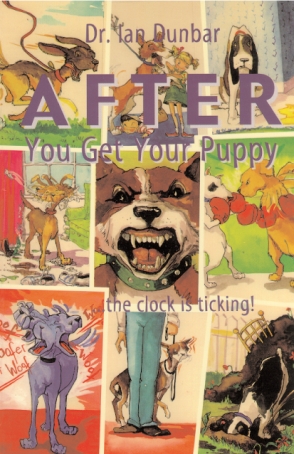
Covers the last three developmental deadlines: 4. Socializing Your Puppy to People, 5. Teaching Bite Inhibition, and 6. Continuing Socialization in The World at Large.
Day 2: Behavior Counseling

All 4 books and 14 videos by Dr. Ian Dunbar at a discount of over 40%.

In this DVD lecture, veterinarian and animal behaviorist Dr. Ian Dunbar addresses one of the most worrying behavior problems any dog owner can face — dogs that fight.

When puppyhood collides with adolescence... you need different training techniques. Successful adult dog training requires controlling the dog’s energy and reactivity to regain attention.