Let's Just Be Humans Training Dogs

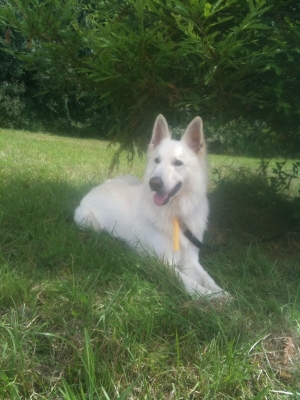
Not A Wolf, White German Shepherd

Basing dog training on a misunderstanding of wolf behavior is as useful as basing human education on a misunderstanding of chimpanzee behavior.

Dogs are not wolves and dog behavior is not the same as wolf behavior. In fact, the most striking difference between dog and wolf behavior is their interaction with people.  Wolves have been naturally selected to grow up to be wary of people, whereas dogs have been artificially selected for their ease of socialization towards people. Consequently, it is hardly sound to use wolf behavior as a template for dog training.
Also, dog-dog interactions are very different from wolf-wolf interactions. Dog behavior is like watching simplified wolf behavior in slow motion. By and large, dogs are easy to read and usually give ample warning (intention signals) of their actions and reactions, whereas watching wolves requires a brain with a few more GHz and a bunch more Gigabytes.

To cavalierly and simplistically summarize considerably complicated canid social behavior as “a dominance hierarchy with an alpha dog dictator”, is an insult to both dogs and wolves, and, advertises a complete misunderstanding of their most sophisticated social structure. Whereas misunderstandings are understandable and excusable, we have to stop at people imposing the weirdness of their misunderstandings upon others. To extrapolate a misunderstanding of wolf and dog behavior to dog training by citing slippery, phantom concepts of “dominance” and “alpha” as excuses to physically bully dogs is both unfounded and quite distasteful.

But regardless of the above, I think we are missing the major point. As intriguing as it may be to observe and debate the development of social behavior of dogs (a subject that formed the focus of my research for nearly a decade), dog social structure and behavior actually have very little, if anything, to do with training! Social behavior and dog training are two entirely separate and distinct disciplines and any notions of wolf, or dog, hierarchical social structure, whether hypothetical or real, are simply irrelevant to the training of dogs. Whether we consider a dog to be a subservient, obsequious wimp, or an ultra-mega, alpha-dominant, human-dissing dog that is plotting to take over, first the family and then, the world … we still have to train the little doggie to like people and to respond reliably to basic manners.

Dog training comprises four aspects of changing the frequency of behavior: 1. Increasing the frequency of behavior e.g., training a dog to settle down more often; 2.Decreasing the frequency of behavior, e.g., training a dog to bark less; 3. Training a dog to respond reliably on cue, e.g., to always sit when requested; and 4. Training a dog to reliably cease responding on cue, e.g., to always stop barking when requested.

Now, certainly, we can use training (classical and operant conditioning) to effectively alter a dog’s behavior towards other dogs and people and by so doing, change doggy social behavior. However, we cannot employ theoretical argument regarding canine social behavior to effectively train dogs, i.e., to teach them to come, sit, lie down, or rollover. Moreover, wasting precious training time going on and on about supposed dominance, alpha and other unlikely suspected causes, severely detracts from getting on and resolving the usually not-too-difficult problems.

Let’s keep it simple. If the dog jumps-up, teach her to sit when greeting people. If the dog pees in the house, housetrain him. If the dog barks excessively at inappropriate stimuli, teach her to Shush on cue.  If the dog pulls on leash, teach him to walk on a loose leash. If your dog wants to eat before you, feed her first — just as long as it’s OK with you. If your dog wants to sleep on the couch or your bed, let him — just as long as it’s OK with you (and your spouse) and the dog will move over or get off the couch/bed when requested.  It’s really that simple; think how you would like your dog to act and then train and motivate the dog to want to act that way. There’s no need for a battle.

If you don’t know how to train the dog, it’s OK. No biggie. Come and learn how.  But please don’t just assume that it’s all the dog’s fault. Don’t reflexively blame your dog. Don’t call your dog names. Don’t assume that your dog is wolfy, or contemplating world domination. And above all, don’t make alpha-dominant excuses to make your dog’s life a misery by psychologically or physically bullying him/her under the guise of dog training. Instead, as a human being with a supposedly superior-functioning brain, give your dog the education that he/she deserves.  As humans, we don’t walk on our knuckles when teaching children to read.


thank you

....for having put this so well, once and for all ! I will be printing this post out and saving it...

Amen

Now how do we get the word out to people not cruising by Dog Star Daily?

Pamela http://somethingwagging.wordpress.com

Thank you, Ian!!!

So beautifully written.  Thank you.  This is going to reach far and wide.   Again, thank you!!

Pat Knittel

("Mom" to two beautiful Malamutes who love to come to snuggle in bed :).  

Deborah Flick

Deborah Flick www.boulderdog.net

Love your post. Your message cannot be shouted from the proverbial roof top too often! 

Bob Dylan

Thanks Ian, . Bob Dylan once said...

Come mothers and fathers
Throughout the land
And don't criticize
What you can't understand
Your sons and your daughters
Are beyond your command
Your old road is
Rapidly agin'.
Please get out of the new one
If you can't lend your hand
For the times they are a-changin'

training labels

Very enjoyable article! I have long felt that we put way too many labels on training dogs. I agree it's not a matter of "dominance" or "submission" but

1. Deciding what you want your dog trained on.

2. Working with the dog rather than lording it over him to train him.

3. And in light of any difficulty repeat:

    It's always the trainer.

    It's always the trainer.

    It's always the trainer.

Sandy Mesmer

about-small-dogs.com

on line course?

jackie earnshaw, cpdt, cpct

Ian, Did I read somewhere that you are going to be teaching an online course soon?

I would be very interested too on an online course

I have long time been wary of the dog-wolf theories.  I am glad to see you also pointing out the folly of this thinking - more people will believe you!

on being human

Yes!

I started out trying to apply Millan's methods - not the mean parts, of course - and found they created anxiety and insecurity in my dog. I abandoned that approach in favour of just being clear, positive, gentle, affectionate, and consistent. My dog, a rescue with reported anxiety and aggression problems, has blossomed into a dream dog. Even my neighbours have commented on how he has developed in a single year of being treated with affection and respect.

Thanks for the affirmation provided by your expertise and experience, Dr. Dunbar.

Of Dogs and Wolves

As someone who has actually trained and worked with wolves and coyotes for many years, this article is right on!  Our domestic dogs sometime resemble their wild counterparts but that is where the similarities often end.  I offer a seminar at Wolf Park in Indiana annually on wolf and dog behavior.  The attendees, many of them experienced trainers, often remark after spending just 3 days around and with wolves, "They are not dogs!".  Hearing experienced trainers say that repeatedly is one of the reasons Wolf Park and I keep offering this seminar.

Often I train behavioral responses with the wolves in the same manner that I teach domestic dogs, i.e. lure and reward, targeting, etc.  But the wild canids usually learn faster, test the perimeters of every behavior response over and over, and they still have an element of neophobia that even extreme socialization does not eliminate.  If you try to train them with "dominance" they will avoid you as the enemy.

Ken McCort, Doylestown, OH, USA

Another Thank You

This past Saturday I attended an expensive, highly-praised (on the Internet) 1-day dog training session with my beloved, sweet, beautiful, 80-pound mixed breed dog. I had registered for this training because Rosie still wants to jump up on people even after 3 years of training.

I started to be concerned when the trainers started talking about how wolves train their young, and then brought out the prong collars. But I thought I would at least give it a try. After the collars went on, the first step was to get (make) the dog sit and stay. My stubborn Rosie refused to sit, even thought at home both on and off leash she does it reliably (well, most of the time). One of the trainers tried to "help" me -- by taking the leash, jerking hard on it and pushing on Rosie's butt to make her sit. She still refused, and because she is very sturdy it was pretty much impossible to force her. By the time the trainer had made a few more attempts, Rosie was growling, snarling, snapping, and trying to bite him. By the end of the day, she was snarling and snapping at everyone except me. The trainers then tried to explain away their lack of success by blaming my dog -- saying she looks like she's part Great Pyrnees, which is a very hard breed to train. I took the prong collar off and gave it back, having no intention of paying for something that at best was ineffective and at worst would turn my dog into a vicious, aggressive animal.

The rest of the day, after we got home, Rosie seemed afraid of me, reluctant to respond to any of the commands she had known since she was 3 months old. I felt terrible -- like I had betrayed her trust. But fortunately, she is very forgiving (although I am pretty sure if she saw that trainer again, she would bite him). Since then, I have gone back to positive training methods. I am sure that with a little more patience, she will learn not to jump on people -- she was already improving before her experience with prong collars. She may never respond as perfectly as these trainers think dogs should; maybe she will never be submissive enough to measure up to their standards. But at least when she does respond, I will know it is because she wants to, not because she is afraid of me.

I wish I had read this article before signing up for the training seminar. I wish I had trusted my better judgment. I commend my dog for having better judgment, and for refusing to obey commands that were "reinforced" with metal spikes poking into her neck. I feel sorry for the other dogs there who weren't stubborn enough to refuse.

Rosiedog

Rosiedog

Indeed, your Rosie had the better judgment there. :-) You were absolutely correct not to purchase that medieval instrument of torture. Clearly, you want a family-like relationship with Rosie based on mutual trust and respect. "Difficult" dogs soon get toughened up and ignore the prong collar anyway. You remember that you are the collar, you are the leash; you direct and protect the dog. There are a lot of people who claim to be dog trainers, who ought to be arrested for being abusers.

Victoria Stilwell has a strategy for discouraging jumping up (very gentle), as does Brad Pattison (more forceful). You can find demo clips on youtube. Also check kikopup, Turid Rugaas, and Monks of New Skete. And good you found Dunbar; personally, I love his respect-based approach.

It takes time, and sometimes we don't realize what we are doing that encourages unwanted behaviours. Do some shoppng around for professional dog trainers in your area; observe their classes in action. Once you find a class whose practices you trust, sign up for a series - it's fun to do doggie school with the pup. We've signed ours up for a 3rd session, this time not with Petsmart, which we enjoyed, but a serious professional outfit whose approach we trust (McCann).

Maybe Rosie could benefit from some agility work - she sounds like she could use a regular workout and she'd be an enthusiastic athlete. A tired dog is a happy dog.

Best of luck.

Not to put too fine a point on it but . .

Your wolf statements are not entirely correct.  Arctic Wolves are not afraid of humans and do not show the traits of their non-arctic brethren.  C.l.arctos have evolved away from humans.  They therefore have never been persecuted by humans and thusly have no inate fear or other ill responses to humans.  No knock against Wolf Park but they don't have any Arctics.  I have been around Arctics and done a little training with them.  They do have the wolf structure vis-a-vis pack structure & family.  Arctics also have some interesting adaptations.  For instance, their ears are rounder, snouts rounder, etc., so as to conserve heat & not freeze.  They are white as adults but are born a charcoal gray color.  Arctics are much more like a dog in training but are nonehteless still very much wolves.  There are only about 60 Arctic Wolves in captivity and not a great number of them in the wild.  Many facilities who think they have Arctic Wolves have merely white colored, gray wolves.  I have seen that with my own eyes and been the bearer of bad tidings to the curators.

As one who has trained dogs, wolves, Arctic wolves and wolf-dogs, training is training is training.  Training is largely respect from bonding.  The biggest difference is that you have far less margin for error in working with wolves and you have to know vastly more about the animals to aviod disaster.  I have never had an injury from any of them.  A good trainer never stops learning.  The animals have much to teach us as well.

Lynn Andrade

Jumping Bean

Hi, Rosie's mom.  Along with FynnMcCool's great advice in her reply, if you'd like my class handout for a jumping dog Rx, just let me know and I'll email it to you.  It's based on the basic sit hand signal Ian's taught all these years; just a bit of added stuff for jumping beans.  Yay for brains over brawn!  Eugenia Vogel, coach@canine-coach.net


Dog Star Daily® Recomended Products:

  • Dog Aggression: Fighting (VIDEO)
    Dog Aggression: Fighting (VIDEO)
     
  • My Dog Can Do That!
    My Dog Can Do That!
     
  • DOGS BITE But Balloons and Slippers Are More Dangerous
    DOGS BITE But Balloons and Slippers Are More Dangerous
     
  • One on One: A Dog Trainer's Guide to Private Training
    One on One: A Dog Trainer's Guide to Private Training