
Topics include: Following. Leash Training (preventing pulling). Leash Walking & Heeling. Preventing Jumping-up.
Can Too Much Socialization Ruin A Puppy?
Dr. Ian Dunbar | Wed, 12/09/2009 - 10:47
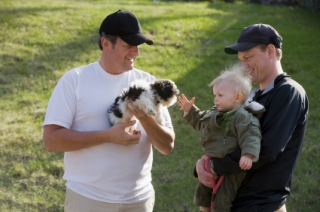
Recently, I read a blog that upset me — Lunch with Turid Rugas: Am I Driving My Dog Crazy, written by an obviously intelligent and caring dog owner, who blames herself for the unlikely likelihood that she ruined her dog Sadie with too much early socialization. My heart goes out to the author and Sadie and I feel that I must respond in case people misinterpret the facts to mean that early socialization can be damaging.
Being fearful and anxious about people and the world can be crippling for dogs, especially if each day, they still have to confront their biggest fears — people and the world. Living with a fearful dog abruptly causes a lengthy lifestyle change and for many months and years, the owner’s life revolves around rehabilitation and protecting the dog from her fears. Most disturbing in this case is that Sadie’s mum is blaming herself for something for which she is entirely blameless.
Feeling guilty and blaming oneself is basically delayed and self-inflicted punishment. As dog trainers, we know that delayed punishment doesn’t work and as people, we know that self-inflicted punishment is the most pernicious. Guilt does nothing to turn the clock back and preventively undo what has been done, nor does it do anything to resolve an existing problem. However, self-blame is an extraordinarily successful way to torture yourself.
Even when we make mistakes, which we occasionally do because we are human, we must always objectively and representatively evaluate our occasional, inevitable and unintentional mistakes along with our usual multitude of successes. You did what you thought was best at the time. You gave your puppy what every puppy requires — ample opportunity to socialize. You did all the right things. But poor Sadie simply wasn’t sufficiently prepared.
It is so very unlikely that too much early socialization exacerbated Sadie’s fearfulness. On the contrary, Sadie’s ongoing universal fearfulness and anxiety only accentuates the crucial need for even more early socialization.
Sadie didn’t require less socialization after you brought her home; she required MORE socialization BEFORE you brought her home.
Poor Sadie was scared of everything and everybody from the moment you brought her home at ten weeks of age. For a puppy to be fearful at eight weeks of age, let alone ten weeks of age, is abnormal. Whatever the breeder had done up to this point was either woefully insufficient, or contraindicated. As a result, by just ten weeks of age, Sadie did not require normal happy-go-lucky, puppy turbo-socialization. Instead, Sadie required immediate and emergency rehabilitation and social therapy.
Socialization is an ongoing process. Specifically, socialization in once you bring a pup home, is all about continuing to socialize already socialized puppies. It shouldn’t have to be about trying to rehabilitate grossly under-socialized puppies. After neonatal handling by lots of people, especially men and strangers (neonatal pups can feel and smell even though they cannot see or hear too well), pups are ready to meet even more people for handling and training before they are eight weeks old. Then the eight-week-old puppy is ready for intensive socialization in the safety of her new home. Then the three-month old puppy is prepared to meet the world at large on walks, in puppy class and in dog parks to prepare her to weather the social storm of adolescence.
Nonetheless, socialization is not about hurriedly forcing a fearful dog to interact with numerous puppies, people and different situations. Instead socialization comprises providing a dog with a multitude of opportunities to explore the infinite sensory and social world at its own speed, carefully monitoring the puppy’s progress and promptly intervening if the puppy is not socializing at lightning speed.
Off-leash puppy classes are designed to identify potential and incipient problems early on so that they may be immediately resolved. For example, bullying (over-the-top play styles) and fearfulness must be resolved week one, or they will only become progressively more difficult to resolve as each week goes by. However, Sadie did not have a potential or incipient problem. By the time that Sadie came to live with you, she had a full-blown, universal fear of the world at large.
I have immense respect for so much of what Turid says. She is a champion of empathy and trying to understand the dog’s point of view. In response to Sadie being enrolled in puppy kindergarten to expose her to lots of different environments, Turid reportedly said, “That’s way too much! It’s over-stimulating for a puppy. Dogs need time to go at their own pace.” However, I worry that anyone reading this might think, “Wow! Puppy classes can damage my puppy and so I won’t enroll her in a class.”
Yes, we have to let dogs move at their own pace but usually, socialized puppies move at a turbo-pace and nothing is too frightening for them. Fast to the point that with most puppies they may be flooded with social stimuli… something that you would never dream of doing with an adult dog, or a fearful puppy. It is very difficult to over-stimulate a two- to four-month-old socialized puppy and there is simply no need to slow things down.
However, socializing a socialized puppy is very different from rehabilitating an insufficiently socialized (shy or fearful) puppy or dog. Whenever a puppy shows any signs of reticence or vacillation whatsoever, it’s time to raise a red flag and slow down. Something is severely wrong. So, it’s time to intervene and resolve the potential problem pronto. Because of an impoverished early environment, or because of extreme sensitivity, or both, some puppies need more time to hide and peek and watch the world go by in order to learn, not only that people are harmless but also, that people are actually enjoyable.
But now, all this is water under the bridge; we cannot turn the clock backwards. Sadly, Sadie is still fearful and anxious about the world and we must do something about it right away. We must embark on a course of confidence-building exercises as soon as possible. For some remedial tips, I suggest you read Retreat ‘n Treat and Fearful Growling. In order to get Sadie to feel confident around people, the use of food lures and rewards is absolutely essential. For the next few months, make sure that Sadie ONLY eats from the hands of people — first from you, then friends and then from strangers. Do not waste valuable food rewards by ever feeding her from a bowl.
Above all, don’t torture yourself with the past. Once you resolve Sadie’s fears, her newfound confidence and quality of life will make you cry with happiness. The journey that you will take together will teach you so much.
Sadly though, Sadie’s situation is all too common — a predicament that is extremely unfair for dogs and extremely unfair for owners. Basically, at just ten weeks of age she was already so far behind in terms of her behavioral development and acquisition of social savvy. Owners must be aware that when they choose a puppy as early as eight weeks of age, either they may choose one that is well-socialized and just raring to go and hit the social scene, or they may choose one that is under-socialized and barely prepared for life in a family, let alone the world at large.
In addition to producing dogs that are good anatomical specimens, breeders must raise puppies according to Open Paw’s Minimum Mental Health Guidelines so that they are well along their socialization journey by the time they are eight weeks old. Yes, we should absolutely socialize and train puppies, as early as possible. But yes, we should also try to feel their feelings in order to adjust the pace if necessary, so as to prevent or resolve their fears as quickly as possible.
Do you want to raise the perfect puppy?
Learn more about puppy training with The Best Online Puppy Training Programs:
The Top Dog Academy. Learn how to deal with puppy biting, crate training, toilet training, socialization and more with videos, worksheets and podcasts about puppy training. When you join the Top Dog Academy you also get access to personalized email support so you can train your puppy yourself. Use this link to get your first month for free.
SIRIUS Puppy Training. Looking for more support? Get personalized, real-time, video dog training guidance from an expert SIRIUS Puppy Training instructor. Dr. Dunbar's SIRIUS Puppy & Dog Training classes revolutionized the world of pet dogs when they were first created. Now, our online small-group classes allow you to get the expert assistance you need from the comfort of your home.
Products from Dr. Ian Dunbar

Day 4: Puppy Classes & Home Training

This little book is intended primarily as a brief but comprehensive guide to puppy training, containing information about socialization, temperament training and behavior modification as well as tips for teaching basic manners.

Day 3: Off-leash Verbal Control, Phasing out Food Lures and Motivating Your Dog to Perform Quickly and Reliably

Learn effective and enjoyable dog training methods that are science-based and ready for real-world dog training.

Bad behavior can ruin your practice. Train your clients to train their dogs and you're clinic will thrive!