
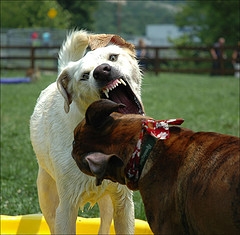


The leash may have triggered the Malamute, but it was going to happen. His approach looked almost predatory and he was stiff as a board and standing on his toes the entire time. The brown dog was very, very savvy and was trying like heck to prevent the inevitable by throwing appeasement signals like campaign promises in early November. (Sorry, the term "calming signal" really grates. Is there anything that isn't a calming signal according to that book?) The brown dog seemed to know that moving away would trigger the Mal. The poor guy was trapped.
All I know is that watching that video in slow motion is like torture! I just kept waiting for something to happen! My stomach was in knots the whole time. If leashes were dropped then maybe Brown Dog would have eventually talked him down. If you notice Brown Dog doesn't move a muscle out of position, just his head. It wasn't until the Malamute was moved out of position that he snarked. Trying to make one last point before leaving? Dunno, but I would be interested in seeing this unfold in real time after the slow mo. It's hard to explain to people just how fast dog communication unfolds!
"In order to really enjoy a dog, one doesn't merely try to train him to be semihuman. The point of it is to open oneself to the possibility of becoming partly a dog." - Edward Hoagland
There have been situations in off leash feisties class where I have seen waiting it out result in the dogs breaking it off, but even in slow-mo this was almost 2 minutes long. (At 0:28 they are nose to nose enough to be time for a greeting. At 2:14 the leash goes tight.) After a minute or so in real time, it was time (if not past time) for the Mal's handler to try to call him off and break the ice.
I think neither owner was paying attention, and the leash tightening on the Mal happened a solid two minutes after the Mal telegraphed his non-approachable-ness to the smaller brown dog. Too bad neither owner was paying any attention. The brown dog's owner could have prevented him from moving into the Mal's circle of harm, and the Mal's owner could have used a cue to change the Mal's focus and 'remind' him that he isn't the sole arbiter of which dog walks where on the public sidewalk! If this was supposed to be a conditioning experience (for either dog) then shame on the owners who were so oblivious to the Mal's attitude, which never softened for even a second. This is NOT how you introduce two dogs when one is known to be reactive.. WTH were the people involved thinking?!?
I had the pleasure of attending a small seminar with Turid Rugaas in 2002. I don't think the general public would have purchased her small (and informative) book if it had been called Appeasement Directives!! (big grin) It was good PR for sales where the public was looking for help with reactive dogs. (Same as the term Feisty Fidos!... fabulous term that most owners can warm up to.)
The tiny book (and even her video/DVD) can't hold all her examples of the signals she wanted to demonstrate. We were lucky to see demos to paint how some dogs exhibit some signals. And yes, there were many... and with her accompanying comments made sense.
IMO, the dogs in the video were given too much time and one made the commitment to react and was given the "go" with the tight leash.
"Calming Signals" was either required or recommended reading for one of the classes I took. Can't recall which one. The book had a big impact on me because it did start to teach me what to look for. I still have my copy. (Can't say that about every dog-related book I've bought.)
My big problem is with the interpretations. There's no allowance for displacement behaviors, or if there is it's lost in the er, translation. (This is true of the calming signals video I saw once too, in a much more apparent way.)
Even without making the huge leaps that I feel Turid makes in reading dog's minds, I feel comfortable in saying that not every yawn, ear flick, or lip lick is a signal. Whether she intends this or not, this is what many people end up thinking.
For example, in the video the look away and/or sniff at 0:16 is outright labeled as a "calming signal." Who knows? It could have simply been displacement for "Oh my! Threat coming!" We don't really know how much of a dog's body postures is signals and how much is just responses. We want them to be signals, but we don't know.
Frequently this is just a minor nit: the end result is the same. The brown dog didn't like the big dog baring down on him like that.
But there have been times I have seen people trying to do things like yawn at their dog in effort to calm them down rather then trying something a little more effective, like removing the dog from the stressful situation in the first place.
quote Eric Goebelbecker "The leash may have triggered the Malamute, but it was going to happen. His approach looked almost predatory and he was stiff as a board and standing on his toes the entire time. The brown dog was very, very savvy and was trying like heck to prevent the inevitable by throwing appeasement signals like campaign promises in early November. (Sorry, the term "calming signal" really grates. Is there anything that isn't a calming signal according to that book?) The brown dog seemed to know that moving away would trigger the Mal. The poor guy was trapped."
That is exactly what I would have said. The Mal also never moved his tail. It was held high and frozen there the whole time. Did the leash trigger? maybe... I think the Mal's owner saw the bite coming and pulled him away AS he was about to bite. He cocks his ear, tilts his head and keeps his jaw in line with the other dogs eyes - the brown turns his head and the Mal follows closely, mimicking the head turn and leaning towards the upper neck, looks like he's going for a bite on the opposite neck/sholder.
Thanks, Steve, for the incredible learning tool this video provides! I absolutely agree with your take that the poorly timed leash tension triggered the reaction.
It seems many humans believe this snark is inevitable, coming like a freight train, unstoppable, and entirely predictable.
I disagree. I think the idea that the poor interaction was intended by the Malamute from the get-go is a common misconception. Although as trainers, we have cleared this hurdle when it comes to behaviors like potty accidents, somehow we are having difficulty extending the idea of immediacy to the social interactions of dogs.
While the initial frames display tension, things go incredibly well, due to the beautiful work of the brown dog in saying "I just want to sniff you. I respect your tension and discomfort. I respect your boundaries. I'm not going to hurt you. Let's be friends." Go, brown dog! I'd like to put that dog on my payroll as an instructor.
So, what would you do if you were the owner of the brown dog and a situation like this happened in your neighbourhood with a strange dog and a clueless owner?
I'll borrow your copy... mine has puppy teeth marks through it. LOL!
<cite>Even without making the huge leaps that I feel Turid makes in reading dog's minds, I feel comfortable in saying that not every yawn, ear flick, or lip lick is a signal. Whether she intends this or not, this is what many people end up thinking.</cite>
I agree... but this is the public seeking information from authorities and they adher to the info like velcro (example: some TV trainers affect the public's "info filtering" by the very fact that they've made it to TV; famous, have a sponsor, each show is a success, etc.)
I only wished to point out that the book shares general information and that, in person, she supported that info with her delightful and kind manner. I guess I'm a bit of a fan of HER because her calm demeanor had such an effect on the demo dogs... perhaps swept up with her personality and not filtering the info myself. LOL!
I really enjoy your contributions to DSD Eric. Please keep them coming so we can have exciting and ah-ha discussions.
Okay, we can all guess at what is going on here and I love the fact that behavior on video is posted so we can all give input as to what we think is going on (love dsd!). Regardless of what you think is going on here...how do we make it better the next time we interact? What can we do to make it a better interaction going forward? That's all I want to be able to address because the deficits in behavior are already in place at this moment. Let's go there....
The little brown dogs lead was quite taut all the time, perhaps both handlers anticipated something. It appeared both dogs where moved away at the close to the same time with the Mal being taht little bit sooner.
Maybe both handlers where uncomfortable with the body language expressed and made a mutal decision to move away (maybe at the MAl's handlers recommendation, as the Mal's handler may be used to the way the dog is - I have a bit of a reactive dog when he is on lead and I will tell people if I think something is about to happen). Both handlers moved the leads at about equally sharpness, so indeed was it the jerking of the Mal's leash, was it the suddeness jerk of the little dog moving away that set the Mal off, or was it both points together? It certainly was something waiting to happen, no doubt about that.
Could the reaction have been avoided without the leash jerk.............there lies the question? I don't think it could have actually, as it was pointed out by emilye2 the little dog was actually trying not to move it's body postion while making all those appeasing gestures, as though it knew if it actuall did move away it would be attacked. the little dog was in a no win situation.
I would not have been happy for my dog to approach the Mal that's for sure. It wasn't a friendly approach, face on, no mutual sniffing of the nether regions etc, like the second dog on dog interaction that happened right after the Mal.
Interesting to see several differing interruptations on the one video.
Dogs do not normally greet face to face in a "normal" setting. There is usually some circling, butt sniffing, etc.
Good rules of leash greetings involve keeping it short so tension doesn't build, lots of loose leash, happy talk if needed, and rewards for polite behaviors such as sniffing - this goes without saying, that if your dog disengages from the other dog prematurely that you should respect this and move away for your dog's sake. Any altercation that occurs past that is the handler's fault.
Ok, I'm going to throw something out there, I would be very interested in what others think?.......... I believe any of these "Spitz" breed types start off at a disadvantage immediately because of the very look of them, which I wonder doesn't that then make them more inclined to be stand offish because they have always experienced and possibly always will suffer a form of discrimination from other breeds of dogs.
lets examine what a dog considered a spitz breed (such as our Malamute friend on the video) looks like: Generally speaking they have pricked ears, hard eyes (very often have light coloured eyes), piloerction (hair/ fur is always errect), tail held high and more often than not tend to walk on their toes, carry themselves very proudly and confidently.......................so what are these poor things indvertently communicating to others?
the same could also be said for dogs that have had their tails docked and ears cropped - and lets face it, isn't the reason for cropping ears to make the dog look meaner? (I am very glad that practice is illegal in Australia, and tail docking is now illegal in most states). Dogs cannot read the very important communication tools of tails and ears if they are not all there.
Is it posible for dogs to show a form of racism towards other breeds - not for the reason humans suffer racism though, but purely because they cannot read the intentions of these certain breeds? Are these certain types of dogs at a disdavantage because of the way they naturally look? I know one of the trainers at a Rottweiler club informed me they had noticed a decrease in inter-dog aggression when the effects of the tail docking ban filtered through in my state.
In turn are these breeds then inclined to be stand-offish and "on guard" because of poor experiences and reactions from other breeds?
I love the input on this video and it was an interesting day with the two dogs. I was holding a dog class on doing dog to dog intros at the shelter and the volunteer brought the Mal out. We had been working on the Mals' dog skills for a few weeks, since he had already had a few run ins with other dogs. The handler holding the Mal at the time was very inexperienced and nervous, as you can see with the leash tension. We stress "loose leashes" all the time at the shelter. This shows why. Thanks for the input on this video. They both found their forever homes. The brown dog had incredible dog skills!
I think you are right to some degree about pricked ears, hard eyes, and other features some types of dogs have that can possibly be offputting to other dogs. However, not ever human is able to read the "look" on another's face - I am fairly sure dogs suffer the same inconsistency in their dealings with each other as well - docked tails or not.
It is nice to romanticize why dogs have trouble reading each other, but really the answer is almost always socialization issues.
I think it was provoked by the savvy brown dog that cleverly hides he is in fact pushy with its three face swipes to the mals face. Notice the greeting with the malinois in the next shot, and then with its long genital sniff. I think the malamute said a lot and the brown dog didn't listen regardless of people and leashes tightening. It looks as though the last face swipe set the mal off and almost at the same time the leash was pulled - could this be a red herring. Even though calming signals or/and appeasement gestures are present it doesn't always mean "I am not a threat". IMHO the malamute knew what was up, and nobody listened.
What can we do to make it a better interaction going forward? That's all I want to be able to address because the deficits in behavior are already in place at this moment.
My initial reaction is avoid on leash greetings. :-) As Erica said, dogs don't normally greet face-to-face and a leash makes a proper greeting almost impossible.
But if that's not going to happen, as Eric G #1 said, loose leashes are key. If there's a dog involved that has issues, some parallel walking sometimes helps. After a few minutes of that, letting them circle by having the people, with loose leashes, ready to follow the dogs in a circle can help. A more experienced trainer coached with that a few times. I'm finding it difficult to describe. Maybe I can arrange to film it.
There's a difference between being friendly and being socially savvy. From my perspective, the brown dog approached quickly without any inviting body language from the Malamute. Once the friendly dog was in its face, the Malamute didn't have a lot of options to express itself and have its personal space respected. I noticed the Mal was also a bit curious about the other dog at the same time. And feeling the pulling on the leash added to its frustration. I have a dog just like this.
When I see my neighbors coming, I smile and cross the street. If they indicate they want the dogs to greet I wave and tell them my dog is in training and can't greet their dog. If someone comes charging at us out of nowhere, and I catch them before they make contact I holler STOP - NOT A GOOD IDEA!!! as we happily back away. The worst situation we have in our neighborhood is the dopes who leave their dogs off leash; those dogs inevitably follow us and I cringe every time - telling the dog to Go Home doesn't work all the time. I make a point of politely telling the owner (if s/he is in sight) that the law (and town ordinance) says your dog must be on leash in public even if s/he is on your property (unless they are in an enclosed yard). It is frustrating at times.
Wanda Woodworth, MA, CPDT Wanda Woof Dog Training www.WandaWoof.com
That's an interesting interpretation. I see the Mal coming in much faster than the brown dog. In the first 15 seconds of the film he (?) covers more than half of the screen while the other dog takes a step, looks, stops, sniffs the ground (probably more of head dip in real time), and then takes 3 more steps. Then the video zooms in to recenter the picture.
This had a lot to do with my earlier assertion that the snark was bound to happen. I think the Mal looks like a guided missile. The brown dog approaches from off screen, but looks a lot more relaxed and his approach is a lot less linear. I hate seeing straight lines when dogs approach each other.
The Malamute had options: turn away (the leash only tightens in one direction, folks), curl a lip, growl (assuming that didn't happen - if it had my interpretation would change) or at least get off of his toes.
I think the brown dog felt trapped and was afraid to turn away, so he went into an active appeasement routine. I don't really have anything concrete to base this on other than seeing a lot of cheap shots taken at dogs as they turn away.
I think this discussion is super interesting too! Sometimes my dog does seem to be in a big hurry to "meet" another dog but turns prickly on first sniff. And when this happens, her body language is still totally iffy from the get-go -- observant dogs (a tiny minority, btw) pick up on this right away and just act disinterested, from a safe distance. That has been the best scenario for us. I also know that's too much to ask of most dogs that don't know my dog.
The brown dog did indeed end up trapped. But if it didn't initially clue in to the "guided missile" posture of the Malamute, turning away or curling a lip may very well have been too subtle to get the kind of results the Mal was looking for. My dog will preemptively make herself look REALLY scary because her hostile body language, low growling, snarling, even an attack like the one in the video, etc. have systematically been ignored by the canine population where I live. They are still mighty keen to jam their noses up her butt. She feels she has to go into full-tilt psycho mode to be understood, and unfortunately, most of the time that's correct. The friendly dogs in my city are THAT clueless. Even if they did get hurt it would be 100% our fault, and I'm not sure what they'd learn from the experience. I also hear about dogs that are attacked "without provocation" like this who become sketchy themselves. It's a big mess!
Conversely, I can tell how relieved my dog is when she meets a dog that "gets her". She can play nicely for hours. I know she is socially maladjusted and doesn't have appropriate expectations regarding other dogs. We have made some progress with ds and cc, but the constant vigilance, having treats IN my hand and dancing around unleashed dogs with her is really tiring. It's a problem.
I feel like I should receive CE just reading them....What a wonderful discussion. I returned from the University of Illinois College of Veterinary Medicine Confernece to find these... terrific!!!!
I hear your message - I will post more of these types of videos.
Let me offer a few comments - No one mentioned the piloerection. To me, that was the biggest indicator that the dog was about to 'go,' I think the taunt leash was a major factor as a I said. You can certainly count the calming signals. I think they are there, for sure. But as Eric points out....Calming signals might be other forms of communication too, and even if not a calming signal what we think is one thing may be another. You MUST look at context. I have no idea if Turid Rugass would agree or not. For example and this is are obvious ones - but make my point. Dog just heard a weird noise, so ears go up. Agressive dog. Nope! Dog yawns. Stressed dog. Nope! Not if Fido (who says Fido anymore) just go up from a nap. Lick lipping. Appeasement? Nope Not if the dog just scarfed down another dog's poop (sorry about that one). Eric, I think, is saying things aren't always as described in Turid's wonderful book, and I would agree. Having said that, the brown dog was clearly throwing signals.
I think the best question is this one?(From Leodoglover)
So, what would you do if you were the owner of the brown dog and a situation like this happened in your neighbourhood with a strange dog and a clueless owner?
Piloerection is one facet of a response - You can't single it out and say the dog is going to attack - Piloerection means something has excited the dog...but, combined with narrowed, staring eyes, "flag" tail and body freeze, then you have enough body signals to say - Uh oh - look out.
I agree Wanda, having said that you look at context and the entire dog....I don't mean the piloerection means a dogs is going to attack. But that is a signal of excitement (as you point out)....that's a red flag potentially....then you point out additional signaling.
I certainly agree that leash tightening launched the black dog into correcting the brown one (the dog would have bitten if it wanted to), but if you look really close you will see the small brown dog ever so slightly lift its muzzle up and almost over the black dog's nose.
The black dog approached this dog with a hard eye-to-eye stare which most likely caused the other dog to offer it appeasement gestures. And it seemed the brown dog might have made a fatal error in raising its nose to the level of the black dog's for a split second before lowering its head once more. And, again, made a terrible mistake when it moved its head to brush along the black dog's left side.
All in all I believe it was completely inevitable.
Throughout the interaction the brown dog several times raised its muzzle so that it was higher than the black dog's. Each time this occurred, the black dog make a slight licking motion. Interpretation of these signals can be subjective, but my interpretation is that the black dog was very uncomfortable with this movement on the part of the brown dog. I don't think the snark was inevitable, because the black dog is one of my dogs in another suit! I think the black dog softened very soon into the interaction, and near the beginning the brown dog was comfortable enough to look in the opposite direction at its handler with relaxed body language. The snark was the immediate consequence of the leash tightening. Did you know that exactly the same could be caused by recalling the black dog had they both been offleash? This has happened with my dog. I can't say why for sure. Perhaps it's because of anxiety at turning her back on the other dog to return to owner. Perhaps the "excited, happy" recall voice arouses an already tense dog into further action before returning to handler. In the case of my dog, I have got to the point that a gentle hand on the collar and quiet request to come away will probably work. If there is a snark the worst harm will be to frighten to other dog and handler.
I also think that spitz breeds will suffer from misinterpretation by other dogs just because of the way they are bred to hold themselves. My dog sited above can now walk relaxed onlead quite close to most dogs. However, a husky-type a field's width away will set her off all high-tail and intense.
Like Death and Taxes
The leash may have triggered the Malamute, but it was going to happen. His approach looked almost predatory and he was stiff as a board and standing on his toes the entire time. The brown dog was very, very savvy and was trying like heck to prevent the inevitable by throwing appeasement signals like campaign promises in early November. (Sorry, the term "calming signal" really grates. Is there anything that isn't a calming signal according to that book?) The brown dog seemed to know that moving away would trigger the Mal. The poor guy was trapped.
--------------------
Eric Goebelbecker
gah!
All I know is that watching that video in slow motion is like torture! I just kept waiting for something to happen! My stomach was in knots the whole time. If leashes were dropped then maybe Brown Dog would have eventually talked him down. If you notice Brown Dog doesn't move a muscle out of position, just his head. It wasn't until the Malamute was moved out of position that he snarked. Trying to make one last point before leaving? Dunno, but I would be interested in seeing this unfold in real time after the slow mo. It's hard to explain to people just how fast dog communication unfolds!
"In order to really enjoy a dog, one doesn't merely try to train him to be semihuman. The point of it is to open oneself to the possibility of becoming partly a dog." - Edward Hoagland
Dropping Leashes
There have been situations in off leash feisties class where I have seen waiting it out result in the dogs breaking it off, but even in slow-mo this was almost 2 minutes long. (At 0:28 they are nose to nose enough to be time for a greeting. At 2:14 the leash goes tight.) After a minute or so in real time, it was time (if not past time) for the Mal's handler to try to call him off and break the ice.
--------------------
Eric Goebelbecker
What happened?
I think neither owner was paying attention, and the leash tightening on the Mal happened a solid two minutes after the Mal telegraphed his non-approachable-ness to the smaller brown dog. Too bad neither owner was paying any attention. The brown dog's owner could have prevented him from moving into the Mal's circle of harm, and the Mal's owner could have used a cue to change the Mal's focus and 'remind' him that he isn't the sole arbiter of which dog walks where on the public sidewalk! If this was supposed to be a conditioning experience (for either dog) then shame on the owners who were so oblivious to the Mal's attitude, which never softened for even a second. This is NOT how you introduce two dogs when one is known to be reactive.. WTH were the people involved thinking?!?
Calming signals...er...
I had the pleasure of attending a small seminar with Turid Rugaas in 2002. I don't think the general public would have purchased her small (and informative) book if it had been called Appeasement Directives!! (big grin) It was good PR for sales where the public was looking for help with reactive dogs. (Same as the term Feisty Fidos!... fabulous term that most owners can warm up to.)
The tiny book (and even her video/DVD) can't hold all her examples of the signals she wanted to demonstrate. We were lucky to see demos to paint how some dogs exhibit some signals. And yes, there were many... and with her accompanying comments made sense.
IMO, the dogs in the video were given too much time and one made the commitment to react and was given the "go" with the tight leash.
Donna
Calming Signals
"Calming Signals" was either required or recommended reading for one of the classes I took. Can't recall which one. The book had a big impact on me because it did start to teach me what to look for. I still have my copy. (Can't say that about every dog-related book I've bought.)
My big problem is with the interpretations. There's no allowance for displacement behaviors, or if there is it's lost in the er, translation. (This is true of the calming signals video I saw once too, in a much more apparent way.)
Even without making the huge leaps that I feel Turid makes in reading dog's minds, I feel comfortable in saying that not every yawn, ear flick, or lip lick is a signal. Whether she intends this or not, this is what many people end up thinking.
For example, in the video the look away and/or sniff at 0:16 is outright labeled as a "calming signal." Who knows? It could have simply been displacement for "Oh my! Threat coming!" We don't really know how much of a dog's body postures is signals and how much is just responses. We want them to be signals, but we don't know.
Frequently this is just a minor nit: the end result is the same. The brown dog didn't like the big dog baring down on him like that.
But there have been times I have seen people trying to do things like yawn at their dog in effort to calm them down rather then trying something a little more effective, like removing the dog from the stressful situation in the first place.
--------------------
Eric Goebelbecker
what happened?
quote Eric Goebelbecker "The leash may have triggered the Malamute, but it was going to happen. His approach looked almost predatory and he was stiff as a board and standing on his toes the entire time. The brown dog was very, very savvy and was trying like heck to prevent the inevitable by throwing appeasement signals like campaign promises in early November. (Sorry, the term "calming signal" really grates. Is there anything that isn't a calming signal according to that book?) The brown dog seemed to know that moving away would trigger the Mal. The poor guy was trapped."
That is exactly what I would have said. The Mal also never moved his tail. It was held high and frozen there the whole time. Did the leash trigger? maybe... I think the Mal's owner saw the bite coming and pulled him away AS he was about to bite. He cocks his ear, tilts his head and keeps his jaw in line with the other dogs eyes - the brown turns his head and the Mal follows closely, mimicking the head turn and leaning towards the upper neck, looks like he's going for a bite on the opposite neck/sholder.
Inevitable?
Thanks, Steve, for the incredible learning tool this video provides! I absolutely agree with your take that the poorly timed leash tension triggered the reaction.
It seems many humans believe this snark is inevitable, coming like a freight train, unstoppable, and entirely predictable.
I disagree. I think the idea that the poor interaction was intended by the Malamute from the get-go is a common misconception. Although as trainers, we have cleared this hurdle when it comes to behaviors like potty accidents, somehow we are having difficulty extending the idea of immediacy to the social interactions of dogs.
While the initial frames display tension, things go incredibly well, due to the beautiful work of the brown dog in saying "I just want to sniff you. I respect your tension and discomfort. I respect your boundaries. I'm not going to hurt you. Let's be friends." Go, brown dog! I'd like to put that dog on my payroll as an instructor.
I'll be posting more of my thoughts shortly.
So, what would you do if you
So, what would you do if you were the owner of the brown dog and a situation like this happened in your neighbourhood with a strange dog and a clueless owner?
Thanks Eric...
I'll borrow your copy... mine has puppy teeth marks through it. LOL!
<cite>Even without making the huge leaps that I feel Turid makes in reading dog's minds, I feel comfortable in saying that not every yawn, ear flick, or lip lick is a signal. Whether she intends this or not, this is what many people end up thinking.</cite>
I agree... but this is the public seeking information from authorities and they adher to the info like velcro (example: some TV trainers affect the public's "info filtering" by the very fact that they've made it to TV; famous, have a sponsor, each show is a success, etc.)
I only wished to point out that the book shares general information and that, in person, she supported that info with her delightful and kind manner. I guess I'm a bit of a fan of HER because her calm demeanor had such an effect on the demo dogs... perhaps swept up with her personality and not filtering the info myself. LOL!
I really enjoy your contributions to DSD Eric. Please keep them coming so we can have exciting and ah-ha discussions.
Donna
So how do we move from here?
Okay, we can all guess at what is going on here and I love the fact that behavior on video is posted so we can all give input as to what we think is going on (love dsd!). Regardless of what you think is going on here...how do we make it better the next time we interact? What can we do to make it a better interaction going forward? That's all I want to be able to address because the deficits in behavior are already in place at this moment. Let's go there....
What Happened
The little brown dogs lead was quite taut all the time, perhaps both handlers anticipated something. It appeared both dogs where moved away at the close to the same time with the Mal being taht little bit sooner.
Maybe both handlers where uncomfortable with the body language expressed and made a mutal decision to move away (maybe at the MAl's handlers recommendation, as the Mal's handler may be used to the way the dog is - I have a bit of a reactive dog when he is on lead and I will tell people if I think something is about to happen). Both handlers moved the leads at about equally sharpness, so indeed was it the jerking of the Mal's leash, was it the suddeness jerk of the little dog moving away that set the Mal off, or was it both points together? It certainly was something waiting to happen, no doubt about that.
Could the reaction have been avoided without the leash jerk.............there lies the question? I don't think it could have actually, as it was pointed out by emilye2 the little dog was actually trying not to move it's body postion while making all those appeasing gestures, as though it knew if it actuall did move away it would be attacked. the little dog was in a no win situation.
I would not have been happy for my dog to approach the Mal that's for sure. It wasn't a friendly approach, face on, no mutual sniffing of the nether regions etc, like the second dog on dog interaction that happened right after the Mal.
Interesting to see several differing interruptations on the one video.
Perhaps if..
Dogs do not normally greet face to face in a "normal" setting. There is usually some circling, butt sniffing, etc.
Good rules of leash greetings involve keeping it short so tension doesn't build, lots of loose leash, happy talk if needed, and rewards for polite behaviors such as sniffing - this goes without saying, that if your dog disengages from the other dog prematurely that you should respect this and move away for your dog's sake. Any altercation that occurs past that is the handler's fault.
Throw something out there
Ok, I'm going to throw something out there, I would be very interested in what others think?.......... I believe any of these "Spitz" breed types start off at a disadvantage immediately because of the very look of them, which I wonder doesn't that then make them more inclined to be stand offish because they have always experienced and possibly always will suffer a form of discrimination from other breeds of dogs.
lets examine what a dog considered a spitz breed (such as our Malamute friend on the video) looks like: Generally speaking they have pricked ears, hard eyes (very often have light coloured eyes), piloerction (hair/ fur is always errect), tail held high and more often than not tend to walk on their toes, carry themselves very proudly and confidently.......................so what are these poor things indvertently communicating to others?
the same could also be said for dogs that have had their tails docked and ears cropped - and lets face it, isn't the reason for cropping ears to make the dog look meaner? (I am very glad that practice is illegal in Australia, and tail docking is now illegal in most states). Dogs cannot read the very important communication tools of tails and ears if they are not all there.
Is it posible for dogs to show a form of racism towards other breeds - not for the reason humans suffer racism though, but purely because they cannot read the intentions of these certain breeds? Are these certain types of dogs at a disdavantage because of the way they naturally look? I know one of the trainers at a Rottweiler club informed me they had noticed a decrease in inter-dog aggression when the effects of the tail docking ban filtered through in my state.
In turn are these breeds then inclined to be stand-offish and "on guard" because of poor experiences and reactions from other breeds?
Here's the set up for the two dogs
I love the input on this video and it was an interesting day with the two dogs. I was holding a dog class on doing dog to dog intros at the shelter and the volunteer brought the Mal out. We had been working on the Mals' dog skills for a few weeks, since he had already had a few run ins with other dogs. The handler holding the Mal at the time was very inexperienced and nervous, as you can see with the leash tension. We stress "loose leashes" all the time at the shelter. This shows why. Thanks for the input on this video. They both found their forever homes. The brown dog had incredible dog skills!
Eric Gilbert - Wayside Waifs KC Missouri
Body Language
Gillians-
I think you are right to some degree about pricked ears, hard eyes, and other features some types of dogs have that can possibly be offputting to other dogs. However, not ever human is able to read the "look" on another's face - I am fairly sure dogs suffer the same inconsistency in their dealings with each other as well - docked tails or not.
It is nice to romanticize why dogs have trouble reading each other, but really the answer is almost always socialization issues.
Another Point of View
I think it was provoked by the savvy brown dog that cleverly hides he is in fact pushy with its three face swipes to the mals face. Notice the greeting with the malinois in the next shot, and then with its long genital sniff. I think the malamute said a lot and the brown dog didn't listen regardless of people and leashes tightening. It looks as though the last face swipe set the mal off and almost at the same time the leash was pulled - could this be a red herring. Even though calming signals or/and appeasement gestures are present it doesn't always mean "I am not a threat". IMHO the malamute knew what was up, and nobody listened.
What can we do to make it a
What can we do to make it a better interaction going forward? That's all I want to be able to address because the deficits in behavior are already in place at this moment.
My initial reaction is avoid on leash greetings. :-) As Erica said, dogs don't normally greet face-to-face and a leash makes a proper greeting almost impossible.
But if that's not going to happen, as Eric G #1 said, loose leashes are key. If there's a dog involved that has issues, some parallel walking sometimes helps. After a few minutes of that, letting them circle by having the people, with loose leashes, ready to follow the dogs in a circle can help. A more experienced trainer coached with that a few times. I'm finding it difficult to describe. Maybe I can arrange to film it.
--------------------
Eric Goebelbecker
BOUNDARIES!
There's a difference between being friendly and being socially savvy. From my perspective, the brown dog approached quickly without any inviting body language from the Malamute. Once the friendly dog was in its face, the Malamute didn't have a lot of options to express itself and have its personal space respected. I noticed the Mal was also a bit curious about the other dog at the same time. And feeling the pulling on the leash added to its frustration. I have a dog just like this.
so what would you do...my answer
When I see my neighbors coming, I smile and cross the street. If they indicate they want the dogs to greet I wave and tell them my dog is in training and can't greet their dog. If someone comes charging at us out of nowhere, and I catch them before they make contact I holler STOP - NOT A GOOD IDEA!!! as we happily back away. The worst situation we have in our neighborhood is the dopes who leave their dogs off leash; those dogs inevitably follow us and I cringe every time - telling the dog to Go Home doesn't work all the time. I make a point of politely telling the owner (if s/he is in sight) that the law (and town ordinance) says your dog must be on leash in public even if s/he is on your property (unless they are in an enclosed yard).
It is frustrating at times.
Wanda Woodworth, MA, CPDT
Wanda Woof Dog Training
www.WandaWoof.com
That's an interesting
That's an interesting interpretation. I see the Mal coming in much faster than the brown dog. In the first 15 seconds of the film he (?) covers more than half of the screen while the other dog takes a step, looks, stops, sniffs the ground (probably more of head dip in real time), and then takes 3 more steps. Then the video zooms in to recenter the picture.
This had a lot to do with my earlier assertion that the snark was bound to happen. I think the Mal looks like a guided missile. The brown dog approaches from off screen, but looks a lot more relaxed and his approach is a lot less linear. I hate seeing straight lines when dogs approach each other.
The Malamute had options: turn away (the leash only tightens in one direction, folks), curl a lip, growl (assuming that didn't happen - if it had my interpretation would change) or at least get off of his toes.
I think the brown dog felt trapped and was afraid to turn away, so he went into an active appeasement routine. I don't really have anything concrete to base this on other than seeing a lot of cheap shots taken at dogs as they turn away.
--------------------
Eric Goebelbecker
agreed
I think this discussion is super interesting too! Sometimes my dog does seem to be in a big hurry to "meet" another dog but turns prickly on first sniff. And when this happens, her body language is still totally iffy from the get-go -- observant dogs (a tiny minority, btw) pick up on this right away and just act disinterested, from a safe distance. That has been the best scenario for us. I also know that's too much to ask of most dogs that don't know my dog.
The brown dog did indeed end up trapped. But if it didn't initially clue in to the "guided missile" posture of the Malamute, turning away or curling a lip may very well have been too subtle to get the kind of results the Mal was looking for. My dog will preemptively make herself look REALLY scary because her hostile body language, low growling, snarling, even an attack like the one in the video, etc. have systematically been ignored by the canine population where I live. They are still mighty keen to jam their noses up her butt. She feels she has to go into full-tilt psycho mode to be understood, and unfortunately, most of the time that's correct. The friendly dogs in my city are THAT clueless. Even if they did get hurt it would be 100% our fault, and I'm not sure what they'd learn from the experience. I also hear about dogs that are attacked "without provocation" like this who become sketchy themselves. It's a big mess!
Conversely, I can tell how relieved my dog is when she meets a dog that "gets her". She can play nicely for hours. I know she is socially maladjusted and doesn't have appropriate expectations regarding other dogs. We have made some progress with ds and cc, but the constant vigilance, having treats IN my hand and dancing around unleashed dogs with her is really tiring. It's a problem.
thank you for all your comments
I feel like I should receive CE just reading them....What a wonderful discussion. I returned from the University of Illinois College of Veterinary Medicine Confernece to find these... terrific!!!!
I hear your message - I will post more of these types of videos.
Let me offer a few comments - No one mentioned the piloerection. To me, that was the biggest indicator that the dog was about to 'go,' I think the taunt leash was a major factor as a I said. You can certainly count the calming signals. I think they are there, for sure. But as Eric points out....Calming signals might be other forms of communication too, and even if not a calming signal what we think is one thing may be another. You MUST look at context. I have no idea if Turid Rugass would agree or not. For example and this is are obvious ones - but make my point. Dog just heard a weird noise, so ears go up. Agressive dog. Nope! Dog yawns. Stressed dog. Nope! Not if Fido (who says Fido anymore) just go up from a nap. Lick lipping. Appeasement? Nope Not if the dog just scarfed down another dog's poop (sorry about that one). Eric, I think, is saying things aren't always as described in Turid's wonderful book, and I would agree. Having said that, the brown dog was clearly throwing signals.
I think the best question is this one?(From Leodoglover)
So, what would you do if you were the owner of the brown dog and a situation like this happened in your neighbourhood with a strange dog and a clueless owner?
Continue to comment away -
Steve Dale www.stevedalepetworld.com
piloerection
Piloerection is one facet of a response - You can't single it out and say the dog is going to attack - Piloerection means something has excited the dog...but, combined with narrowed, staring eyes, "flag" tail and body freeze, then you have enough body signals to say - Uh oh - look out.
Best,
Wanda Woodworth, MA CPDT
www.WandaWoof.com
Piloerection
I agree Wanda, having said that you look at context and the entire dog....I don't mean the piloerection means a dogs is going to attack. But that is a signal of excitement (as you point out)....that's a red flag potentially....then you point out additional signaling.
Steve Dale www.stevedalepetworld.com
Piloerection
I agree Wanda, having said that you look at context and the entire dog....I don't mean the piloerection means a dogs is going to attack. But that is a signal of excitement (as you point out)....that's a red flag potentially....then you point out additional signaling.
Steve Dale
www.stevedalepetworld.com
Let my muzzle cross yours? Please?
I certainly agree that leash tightening launched the black dog into correcting the brown one (the dog would have bitten if it wanted to), but if you look really close you will see the small brown dog ever so slightly lift its muzzle up and almost over the black dog's nose.
The black dog approached this dog with a hard eye-to-eye stare which most likely caused the other dog to offer it appeasement gestures. And it seemed the brown dog might have made a fatal error in raising its nose to the level of the black dog's for a split second before lowering its head once more. And, again, made a terrible mistake when it moved its head to brush along the black dog's left side.
All in all I believe it was completely inevitable.
Throughout the interaction
Throughout the interaction the brown dog several times raised its muzzle so that it was higher than the black dog's. Each time this occurred, the black dog make a slight licking motion. Interpretation of these signals can be subjective, but my interpretation is that the black dog was very uncomfortable with this movement on the part of the brown dog. I don't think the snark was inevitable, because the black dog is one of my dogs in another suit! I think the black dog softened very soon into the interaction, and near the beginning the brown dog was comfortable enough to look in the opposite direction at its handler with relaxed body language. The snark was the immediate consequence of the leash tightening. Did you know that exactly the same could be caused by recalling the black dog had they both been offleash? This has happened with my dog. I can't say why for sure. Perhaps it's because of anxiety at turning her back on the other dog to return to owner. Perhaps the "excited, happy" recall voice arouses an already tense dog into further action before returning to handler. In the case of my dog, I have got to the point that a gentle hand on the collar and quiet request to come away will probably work. If there is a snark the worst harm will be to frighten to other dog and handler.
I also think that spitz breeds will suffer from misinterpretation by other dogs just because of the way they are bred to hold themselves. My dog sited above can now walk relaxed onlead quite close to most dogs. However, a husky-type a field's width away will set her off all high-tail and intense.