
When choosing a dog trainer, buyer beware!
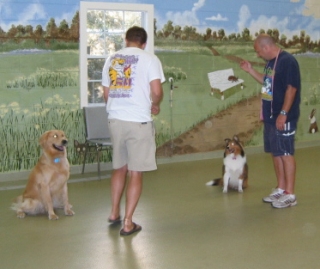
Training tools aren't required in this off-leash class

Before 1981 when Dr. Ian Dunbar developed the first Sirius Puppy Class, training wasn't recommended for puppies under 6 months old.  The only training methods available at the time involved physical force using training tools such as choke collars, and were considered to be too harsh for young puppies.  Dr. Dunbar created the lure/reward method, which opened up an entirely new perspective on dog training in general.   With this method, instead of being corrected for wrong behavior, puppies are set up for success by being lured into the desired position then rewarded for achieving the behavior.  Unlike traditional dog training, with no force, fear, pain or intimidation inherent in the technique, it was now appropriate for puppies as young as 8 weeks old to begin training classes.

Lure/reward training proved itself to be so effective, efficient, and fun for both owners and dogs that the usage spread to family pet obedience classes for all ages. Eventually it expanded to more specialized areas of dog training, including dog sports, working dog activities and conformation.  Clicker training, another reward-based training methodology without the use of corrections, was also developed in this time frame and grew greatly in popularity.

Research presents compelling evidence in favor of reward-based training

Over the last 30 years, animal behaviorists have studied the undesired effects of training with aversives.  Dr. Karen Overall,  noted veterinary behaviorist, is quite adamant about her views on shock collars and states, "Shock is not training - in the vast majority of cases it meets the criteria for abuse."    According to a veterinary study published in 2009 in the Journal of Applied Animal Behavior, if you're aggressive to your dog, your dog will be aggressive to you.  Meghan Herron, DVM, one of the lead authors of the study, says, "Our study demonstrated that many confrontational training methods, whether staring down dogs, striking them, or intimidating them with physical manipulation, do little to correct improper behavior and can elicit aggressive responses."  Dr. Sophia Yin, another well-respected veterinary behaviorist, adds, "Indeed, the use of such confrontational training techniques can provoke fear in the dog and lead to defensively aggressive behavior toward the person administering the aversive action."

Best-selling author and dog behaviorist Jean Donaldson states in her article entitled Modern Dog Training vs. Cesar Millan, "The force-free movement has been partly driven by improved communication from the top.  Applied behaviorists, those with advanced degrees in behavior, and veterinary behaviorists, veterinarians who have completed residencies specializing in behavior problems are in greater abundance than in previous decades, and there is much more collaboration between these fields and trainers on the front lines. These two professions are quite unified on the point that the use of physical confrontation and pain is unnecessary, often detrimental and, importantly, unsafe."

Our own Dr. Dunbar says in an article entitled The Trouble with Punishment, "Sadly, many outdated trainers, and hence many owners who have read outdated training books, tend to focus on punishing untrained dogs for getting it wrong, for breaking rules they never knew existed. It is much quicker to teach your puppy the rules of the house - to show him what you want him to do and to reward him for doing it."

Over the years, more trainers are choosing to reward instead of correct, and more owners are becoming aware of the difference and discerning about their choice of a trainer.  With such compelling testimony, it should be easy to find a trainer who uses modern, scientifically sound positive reinforcement-based techniques, and those who continue to hang onto the old, outdated methods should be going the way of the dinosaurs, right?

Wrong.

Why dinosaurs still roam the planet

Why would any dog owner or trainer choose to set up a dog as an adversary that needs to be conquered when the goal is to have a companion?  Even back in the old days when I took one of my dogs to a class using choke chain corrections, I was having trouble with this concept.  I was uncomfortable with having to do unpleasant things to my dog then, when there wasn’t an alternative.  Now that there are excellent alternatives, what could possibly be keeping choke, prong, and shock collar manufacturers  in business?

In great part I blame Cesar Millan  Using outdated and debunked wolf pack/dominance mythology as his basis, he has gained great popularity playing the part of a dog expert on TV.   His whole shtick is about creating drama by wrestling “dangerous” dogs into submission so that viewers will continue to tune in for the excitement.  Even though he himself admits that his techniques are all for show by warning viewers not to try them at home, dog owners and even trainers buy into the illusion.  Granted, it would be pretty boring to watch an aggressive dog being treated by slow, systematic desensitization and counter-conditioning, which requires keeping the dog calm at all times to be truly effective.  It’s far more exciting to set the poor dog up by throwing him into a situation where he has no choice but to react violently out of fear, and then show our hero saving the day by physically dominating him.   Cue music and flashing red lights.  Pure and simple, Millan has set dog training back 30 years by making dog abuse sexy.  It’s disgusting.

Modern training based on scientific research is fairly new, so another reason we still have force training is because people don’t like to change.  It’s human nature to cling to what is familiar to us, and we don’t like to fix what seems to work.  Granted, force training does work.  You can intimidate any living creature into compliance with the use of fear and pain, which are powerful motivators.   So if a trainer has been using prong collars for the last 30 years, he’s going to be heavily invested in justifying his methods anecdotally and tend to scoff at the research that potentially could prick little holes in his belief balloon. 

Then there are the people who feel powerful if they can physically dominate another living creature.  Let’s just hope that this is the minority of dog owners/trainers who use force methods.  And I really wish I could believe that, but I think that attitude is far more prevalent than we would wish.

And, of course, there are just those who have not yet heard the gospel.  The literal translation of gospel is "good news," and it's up to us reward-based trainers and behaviorists to educate the public by spreading it.  It's very good news indeed that we don't have to hurt or intimidate our dogs into behaving for us!

Choosing the right trainer

Because of the new wave of enlightenment about training techniques, force trainers have to be much more careful with the way they advertise so that they don’t lose potential clients.  If you look at these trainers’ websites, many of them will not even mention the way that they train or what tools they use.  You may have to study the pictures to discern whether or not choke, prong or shock collars are used in their training.

Cute little euphemisms are also getting more popular.  For example, shock may be called a “tap,” “stim,” or a “muscle stimulator.”  The quick jerk of a choke collar that produces the startling sound in a dog’s ear has always been called a “pop.”  Says Jean Donaldson “The force-free movement gains momentum every year and a sure sign of this is that many trainers in the other camps resort to murkier and murkier euphemisms to disguise their more violent practices and retain their market share. Stressed dogs aren't 'shut down,' they're 'calm.' It's not strangling, it's 'leading.'"

Even the terms “positive reinforcement” and “dog-friendly” have been hijacked.  Many students have reported responding to an ad for a “dog-friendly” trainer who turned out to require prong collars.  If they happen to use treats at all, they may label themselves “positive reinforcement” trainers.   Many of the trainers who throw treats along with using corrections will call themselves “balanced” or “eclectic” trainers.  

If you want a truly dog friendly trainer or training class that uses modern, scientifically researched positive reinforcement training techniques, you will have to research past the advertisements.  Certainly the tools required (choke, prong or shock collars) are a dead giveaway.  But there can still be force and coersion used even if these “training” collars aren’t.  Beware of yelling, poking, jabbing, objects being thrown at or near the dog, loud noises used for startling, physically forcing dogs into position, alpha rolls or any kind of pinning,   etc.   Any reference to the words “alpha” or “dominance” should also make you sit up and take notice, as that's a good indication that the trainer is leaning on that nonsensical old myth.

The best way to determine whether or not a training class is right for you and your dog is to ask to sit in on a session.  If your trainer won’t allow this, that could be a warning bell. Look for signs of stress in the dogs, such as tails being held low and into the body, mouths tensely shut, avoiding eye contact, crouching.  You should see happy, eager, relaxed dogs and people having fun.  If you feel uncomfortable with anything that you see, look elsewhere. 

Find a dog-friendly trainer

Truly Dog Friendly Trainer Roster

Pat Miller Trainer Referrals

Karen Pryor Academy Trainer Referrals

Jean Donaldson Academy Trainers

Additional resources

How to choose the right dog trainer

Choosing the right dog training class

What to expect from a basic dog training class

Dog training tools and how to use them

Naked dog training

Dog training in a fast food society

The Milgram Experiment and how it relates to dog training

Leadership and the family dog


Excellent article

Thanks for an excellent article that I can steer people to - I have been utterly bewildered by the number of people who continue to use aversive methods when the evidence is overwhelming to me that there is a better way.  And I shall enjoy reading the references, too.

Great reminder article on

Great reminder article on how we need to keep working at it.

No doubt the CM fans will come out and create hysteria about CM bashing, but you cannot get around the science of it all. I recently went to a Behavioural conference and the two renowned veterinary behavioural specialist (one from Canada and one from Australia) both agreed that CM has started to change what he displays on his show - however it was their belief he did not understand why he was changing, as he still clings to the dominance theory explanation.

Those that are ready to leap to CM defence, one episode should help you at least think a little differently, was about a dog that loved to tear tissues from a box. CM described to the owner the dog was being dominant over the owner and the box. This is utter rubbish - the dog was just having fun. Yes the method CM chose to correct the "problem" was great (environemental enrichment - first time I ever saw him do it too!) but he clings desperatly to this dominance theory.

Skip over to Dogtown and the many wonderful, patient dog trainers, veterinarians and other staff within the facility. The whole feeling of the show is of serene calmness. I think John Garcia could give CM a real run for his money in the charismatic department too and his passion for what he does really shines thorugh presenting a genuine desires and compassion for the dogs (as do the others in the show). It's all about the dogs/animals for Garcia (and the others of DOGTOWN) not their egos................unlike others.

Leah I think you hit the nail on the head when you say some think themselves powerful, mastering a beast and some do it from frustration, it makes the person feel better even if it doesn't achieve anything. I will agree, just like any training, the gentle modern method is not without fault, usually a result of incorrect timing, but I don't want to hurt my dog from frustration using excessive force and punishement when all I need to do is withhold the reward or the object of desire.

Well Put!

I am going to print some copies of this blog and carry it with me to hand out, as necessary. I am so tired of hearing CM this, CM that. In my mind he's right up there with the political theatrics of GB and RL (I'm sure you can figure out who I'm talking about). This blog is very succint and to the point as to appropriate training methods and to make people hopefully think about how they treat and train their dogs. We don't allow our dogs to bite us when they are angry about something, trying to get our attention or telling us they want something, such as to go outside to potty; why should we inflict pain on them when the roles are reversed?

I helped walk dogs thru an agility course at our local humane society fundraiser this weekend and some had prong and choke collars on in addition to their ID collars. All of the dogs were very sweet, though, despite their owner's choice of outdated equipment and hopefully the owners learned something from the many positive training booths there.

Important Article: Case in Point...

Great job on this article, Leah!  Just to illustrate one of your points, I recently consulted about a young deaf dog who had developed a lot of fear behaviors.  His owner, a sensitive and wonderful woman, had been given a shock collar by another trainer and told that it was "not shock, but only a vibration to get his attention."  When the owner discovered it was actually shock that caused avoidance behaviors, she immediately stopped using it, but the damage had been done--to the extent that the woman felt bad and had lost all confidence in herself.  This young dog responded very quickly and positively to non-aversive and relationship-oriented methods.  In addition to the dog's quick responsiveness and return to being a joyful boy, it was great to see the owner's confidence growing quickly.  She will now do just great with this dog!  Thanks for this article that's so well done!

Rise VanFleet, Ph.D. www.playfulpooch.org


Why is there only one way?

  For some reason, when it comes to dog training/behavior, dog owners must choose a beaten path and stick to it.  Everytime I read a blog about nearly any issue on this website, Cesar Millan is bashed in some way, etiher by the blogger or the readers.  I really don't understand the hatred for an individual, regardless of his methods, who has only increased the interest in learning about dogs.  Far too many times families purchase/adopt dogs and leave them to a life locked in a house or backyard.  There is no doubt that Cesar loves and cares for dogs, and his motive, just like the many trainers on this website, is to create better lives for dogs and their owners.  The books he writes are best sellers.  He has tremendous power with his popularity and has succeeded in creating more interest in learning about dog behavior and training.  His latest book is filled with training methods from various trainers including Ian Dunbar.  He does not descriminate against any methods unless they are outright abuse.  Yet all "modern trainers" have nothing but negative reviews of his methods.  The anti-Cesar movement sensationalizes what they call abusive techniques and make it seem like he alpha rolls every dog with which he comes into contact.  He's a one man alpha rolling machine.  He simply walks near a canine and they shutter with fear.  It's ridiculous.  I often stumble across some silly post about a particular video clip that is "horrifying" and think wow, he must have done something terrible.  Then I watch the clip and shake my head at how far people will run with the truth to push an agenda.  The common quote "He's set dog training back 30 years" makes me laugh every time I see it.  This sort of bashing comes off as insecurity and envy.  The man loves dogs and cares about helping people just like the rest of you.  


P.S. I use any training technique that I feel will give me and my dog the greatest success.       

Some of his methods are aversive

As a layperson who is intensely involved with her dogs and constantly learning what I hope to be the most humane methods of training, I feel very strongly that much of what people watch on television is not reality for training your dog. I, too, used to watch Cesar Millan and get a kick out of his "quick' fixes. However, after adopting and training a pit bull puppy, by using a positive method trainer, I now watch his show and see how fearful many of the dogs he handles really are.

I can truthfully say that with both my dogs, I've never seen them cower from me or my husband in fear; they don't have to worry about being choked by hanging them up with their collar to get them to submit, or placing them in a situation that terrifies them, such as some of the flooding techniques CM has used. One of the most horrendous shows I watched was a tiny dog that did not like being shaved/groomed. He actually held it down and forced the shaver on it and it bit the crap out of him. I think he followed it up with comments to the owners that they had to be the "dominant" one and show the dog who was boss. That pretty much did it for me.

I am a follower of this site because the training tips work, they are humane and they have worked with a shelter puppy and a 1-yr-old pit mix shelter dog who came to our household with no training and not much dog-to-dog socialization. My dogs are wonderful canine citizens and we have never had to force them to do anything, other than being firm with them, if necessary. That's usually accomplished with a "hey" and a look.

This is my two cents in defense of the reasons why many trainers think Cesar is doing a disservice to the public. I believe he was getting so much flak from positive trainers that that's the reason his recent book includes Dr. Dunbar and others. Just my opinion, though. I don't watch him, don't tell others to follow him and while he is charming and of course he's done great good for the pit bull breed, his training is not my cup of tea for the reasons stated herein.

Professor John Bradshaw

This science professor from the University of Bristol in the UK has studied domestic dogs for 25 years and a recent article I read contains some of his comments related to Cesar's methods that are worthwhile reading. I would be most interested to read his recently published book, "In Defence of Dogs." Hoping it comes to the US soon.

A quote from the article: "He is a smart guy [Cesar] and sees which way the wind is blowing. He is now embracing reward-based methods. All that stuff he spouted about wolves was not based on science." There are also comments that Cesar was taken to task (my words) for his methods being close to breaching Defra guidelines (harsh training methods) in the UK.

The article can be found at the following website: www.guardian.co.uk/science/2011/jul/17/dog-training-john-bradshaw-animal-behaviour


US edition

Professor Bradshaw's book is published in the US under the title "Dog Sense: How the New Science of Dog Behavior Can Make You a Better Friend to Your Pet".  Published May 2011, by Basic Books.  ISBN-13: 978-0465019441

Thanks FJM

Thanks for the info. FJM. I see my local independent bookstore has it. I know where I'm headed after work!

I am a big believer in

I am a big believer in science and learning theory (it should be called "learning law") and both very clearly state that a dog best learns from being rewarded for the "Right" (desireable) behaviors. Both also clearly state that using aversives can result in some pretty dangerous potential fallout. Is EVERY dog going to have some sort of fallout (fear, aggression, shut down etc...)? No. But I would rather stick to a method that has a 100% likliehood of success than a method that has even a 95% likliehood of success. Why settle for less? There is no logical reason.

I believe Cesar Milan loves dogs, but I also believe that Cesar Milan loves his plush lifestyle. It is only recently that he has started to embrace positive methods, and even now he is sticking to the "dominance" explanation. I would like to believe that he has changed because he is starting to learn more about actual dog behavior (social hierarchies included) and learning theory, but truthfully in my gut I feel that he is only doing it because so much more awareness is being raised about force-based methods and he doesn't want to lose any of his following.

I love it when he chooses to use positive methods and think it is wonderful that he is an advocate of getting out and exercising your dogs (as an active person I love the feeling of being out on a run with a trusty pooch at my side)... be that as it may his methods are not fun for the dog or (typically) for the people. Training should be a relationship-enriching experience for the dog AND the handler. It should be fun and safe at all times. My observation has been that with aversive methods handlers get very emotionally involved when their dog gets it "wrong" and that emotionality shows in their corrections (which are often not only poorly timed but far too harsh.) With positive training, however, my observation is that handlers do not get as frustrated because they are working *with* their dog, not against, and because their dog is eagerly thinking, thinking and thinking... which most people really enjoy watching.

As I said, not every dog will experience potential fallout, but unfortunately the dogs who don't experience any fallout are in the minority. It is hard enough to get a handler to give a reward with awesome timing, but at least even if the timing is poor there is no fallout and it is easier to adjust than timing a correction "properly" because a poorly timed (indeed, even a well-timed) correction can (and often does) result in a case of mistaken association. 

I am glad Cesar Milan sparked an interest in taking a more active role in your dog's life, but am very sad that his methods have caused so much damage to dogs and handlers everywhere. I go with the science, and science says that we do not need aversives to raise our dogs (even dogs with severe behavioral issues) to be fantastic companions. I choose science-based, safe and fun training every day of the week=)

Thanks for the article, Leah. Wonderful<3<3

Dog Star Daily® Recomended Products:

  • SIRIUS Puppy Training Classic (VIDEO)
    SIRIUS Puppy Training Classic (VIDEO)
     
  • Training Dogs With Dunbar (VIDEO)
    Training Dogs With Dunbar (VIDEO)
     
  • Training The Companion Dog 1 Socialization &amp; Training (VIDEO)
    Training The Companion Dog 1 Socialization & Training (VIDEO)
     
  • Doctor Dunbar&#039;s Good Little Dog Book
    Doctor Dunbar's Good Little Dog Book