
What’s the deal with food & bribes?
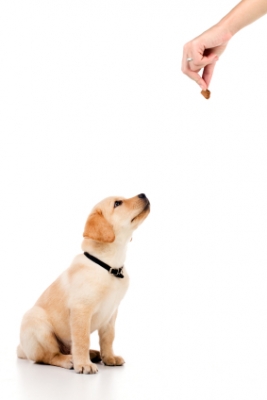
Often when I am working with clients there are questions about food rewards. The main concern it seems is “Will I have to use treats forever? The second question is the often misunderstood notion that the food is a bribe. It can be, if used in the wrong order.
Let’s first get a few things established. 1 – Shifts in context create behavior changes and secondly consequence drives behavior. Dogs do not do things simply because they are filled with undying servitude; dogs do things because it pays off in some way.
Ok, so the food issue goes into the motivation category and then there is also a subtext involving owner’s who are savvy. I say this not in a condescending way, dog people are so sensitive, I say this because motivation is always shifting, just as contexts are always shifting. So decide how you’ll pay your dog so the wanted behaviors increase, and get a handle on how to humanely deliver consequences so the unwanted behavior decreases. That is the deal, it’s not my opinion it’s science, it’s how dogs learn.
You may have had luck with your dogs kibble in the back yard while he was hungry; however after that full meal when he’s on a leash walk he may not want food. The key here is to use food wisely, and pay attention to what motivates the dog.
Using food to train obedience is fine as long as you are delivering the reward of food right after the behavior occurs. When doing sits or downs do not feed the dog when he pops up! Retract the food and reset the dog, the dog should be paid for the position, not for popping up. I see this quite a bit in public classes. People just feed the dog for any old position even though they are working on a specific position. Dogs figure out really fast that breaking the sit is what is getting them paid most of the time.
Preferably there should be some type of reward marker, the most well known is the clicker. Seeing as clickers are not always handy, many people use YES or NICE, there is an inherent salient response by dogs that hear the sss sound, when said in a happy tone. You can also try “You’re the bessst”! or “Excellent choiccce”!
Here is are the common problems surrounding food rewards, delivered too late, inconsistent both in quality and quantity, low or inconsistent rate of reinforcement, delivered before the behavior, and worst of all delivery of food reward followed by some type of aversive. The most common I have found is bribing the dog into a crate by throwing the food in then the dogs goes in and the person locks dog in crate for hours.
Decide what you’re paying with and what you’re paying for as well. Don’t just toss food to the dog for everything. Make it count.
Mechanics and timing are essential to be a good dog trainer. Having patience is also very important as well. When dogs have a learned experience and it’s pleasing, and the sequence is one that predicts good things dogs are much more motivated.
Recently while working with my leash reactive dog Keyshia, my wife suggested I pay her for focusing in on a dog barking in the distance. As Keyshia was bouncing and prancing and chuffing I said” I have changed my criteria”. I no longer pay her for hearing dogs bark, or even seeing dogs provided I had the correct distance. During the first year of trails, and they were cold trials every time, we used turkey, cheese, salmon, you name it we tried it. It helped immensely; we got in the door along with vigilant situational awareness and making sure the rehearsals of her reacting were kept to pop ups out of nowhere as much as humanly possible, which is why I am an excellent sprinter by the way.
The day Keyshia turned her around at the sight of a dog before I could mark with YES! I knew we had made progress. From then on I carried medium grade treats. I shifted my criteria to using jolly talk for any dogs she could not see, but hear.
I only fed her for dogs where she would notice and stay under threshold. It does not hurt that she has a stellar, look, Leave it and Touch command. I did use food rewards to get those instilled and reinforce them with food to this day if needed.
Let’s fast forward to Keyshia’s current status. If she does not get popped up on or gets frightened, which is rare, I do not feed her on walks. I can jolly talk her out of most seen and heard dogs. Even when people get a bit close and she gets a Hebe gee bees I can say, “It’s ok good girl c’mon”, and if it’s before a meal I might give a small piece, yea I’m a softy.
Many people just toss food at the dog the second they start to display anything other than nice walking behaviors. You may get the dog to stop reacting, you may not, what you are really doing is backwards conditioning. In order for the counter conditioning to be effective the dog must see/hear the dog first and then be rewarded. This goes for basic training as well, the dog must be rewarded after the behavior, not before or during.
During a discussion at Dr. Dunbar’s home last year he spoke about the problem of food as a crutch. I agree it can be. I see it all the time. Its human nature, if the food is successful and the humans get results they figure it’s the key to unlocking the mysteries of communication. It’s not. It’s a tool. The good news is we have to feed our dogs anyway, so why not make it count? Just do not rely on it always and forever. I suggest people carry food on walks, it’s better to have a gun and not need it than to need a gun and not have it. ☺
For puppy owners this is mandatory. There are many ways to use food when training a puppy; if you’re not using food in puppy training you are really short changing yourself.
In the case of rescued dogs or dogs that are having issues with fear based behaviors, again it is essential that food be used in some way to pad, or reward the dog for dealing with the fear, obviously always on the lookout for flooding and over threshold scenarios.
In the training of dogs who are just happy go lucky with nothing but basic manners training, again it should be essential in the beginning and as with any training or behavior modification protocol, your awareness of the behaviors changing or not changing are directly related to the outcome. So keep notes and be aware of contexts in which the dog is successful and other contexts where the dog was not successful. Go slow and set the dog up for success by working in environments where the dog has had success.
You can balance out the food rewards with life rewards. To this day I have rarely used food with Keyshia to train her manners during play. It has been 99.9% operant conditioning. Her drop it’s in the game of Tug are rock star status, her ability to self regulate in play with humans and dogs is remarkable, split second disengagements with one verbal request of “ easy” “ leave it” or “that’s enough”, why? Time outs; simple as that. Again, timing is everything, along with consistent rules and setting zero tolerance policies.
Keyshia is motivated to PLAY! Play with me is perhaps her biggest reward, so the removal of it provided the perfect consequence for driving the type of behavior I wanted to shape in her. Finding the motivation in the context is the key to being successful outside of the house where it the world is full of surprises and competing motivators.
Absolutely none of this is new or revolutionary, it’s been around for well over 60 years. The good thing is that it works, if you know how to use it.
The bad news is there is so much misinformation about dog training that many people are confused or led down the path of domi- nonsense.