
Treating your dog like your kids? Let’s hope so!
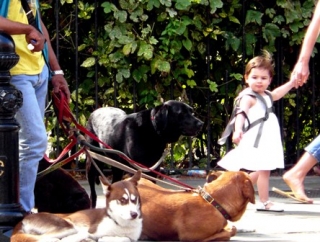
dogs and kids karen wild blog

It’s often the case that you hear a criticism levelled at some dog owners. The reason, it is stated, that their dogs do not behave is this: ‘The dog is their baby’. The owner can rather tragi-comically be portrayed cuddling the dog and buying it diamante accessories. Everybody shakes their heads in disbelief. This apparently leads to all sorts of unwanted behaviours in the dog. The dog is sometimes then punished – it is ‘spoilt’, ‘naughty’, ‘cosseted’. The list goes on. The statement is ‘This dog behaves like this because they treat it like a child’.

And yet, I always felt a certain unease with the comparison. I work with dogs and I work with children. Some of them – in both groups - are pretty tough to handle! In children, what we might call ‘challenging behaviours’ can be highly disruptive and interfere with group activities, or with their own learning.

Has that behaviour arisen because they were somebody’s ‘baby’? That it was treated ‘like a child’? Was it because they were cuddled or bought treats by their parents?

So here’s my view. I would hope that yes, most dogs are treated rather like some people’s children.

Some kids aren’t allowed to behave in a way that may disrupt others or cause harm. They are taught the social rules and learn to control their impulses to yell, race around, snatch things, fight, and all the other things you see children attempting. In parallel they are given life lessons in how to deal with frustration, what games are suitable, and how to be successful without confrontation. If there are sometimes things they would rather not do, they learn that at times they must comply, whether they like it or not. In return, their parents try to take the pressure off and let them just be themselves when there is not much call for ‘behaving’. Parents hope they will learn that successful outcomes do not always come from screaming and shouting.

It’s easier when they are little to do this of course – and ongoing, as they develop into adolescence, I’m sure these challenges grow. Altruism does not come easily to kids nor dogs for that matter. It’s just a method of survival that they need to learn in a society.

I feel that the best behaved dogs I know have the best behaved children in their family too. Rules don’t have to be harsh – in fact, I prefer ‘firm and fair’ – and experienced parents/dog handlers do get what they want without the heavy stuff we sometimes see on TV.

And you can still buy treats, cuddle them (if they enjoy that) and act kindly towards them.

So a dog, who clearly is not a human being, has to be viewed in their own way. They aren’t children. But they aren't toys, either. As we all know, some dogs don’t enjoy cuddling and other signs of affection that humans give out. And yet, to get good results, they must still be taught with the rules, common sense and fairness that I mention above.

Yes, they will get it wrong and yes, sometimes with all the sense and hard work in the world a dog or a child may end up in a pickle. Nevertheless, treating them ‘like kids’ just isn’t the issue.


Copyright Karen Wild www.karenwild.co.uk www.intellidogs.com

Photo: Roma Flowers (raflowers)



Yes!

I'm really glad you wrote this!

I'm convinced that the people that "spoil" their dogs would "spoil" their children too. I have also had the displeasure of seeing this belief proven too. I've needed ibuprofen afterwards, every time.

But I still struggle with this analogy. On the one hand good child raising and good dog ownership have a lot in common. On the other I have met people who seem to have forgotten, or at least are overlooking the fact that their dogs are, well, dogs.

At a certain point you can, or at least you ought to be able to, reason with your children. You really can't with dogs. You can communicate an awful lot to them about actions and consequences, but you can't reason, and they will still be motivated by things that (most) children will grow out of.

Last, while I am slowly learning to embrace the term "pet parent," I still find "furkid" and "furbaby" kinda creepy.

--------------------
Eric Goebelbecker
eric@dogspelledforward.com

Dogs aren't kids but they are individuals

My take on this is that, although I think Eric is right, we can't reason with dogs and explain to them with words why a certain behavior is preferred over another, it is productive comparison to think of a dog as a being that is similar to a human child. The essential similarity being, I think, is that both are living, thinking, dynamic social animals that must be taught to behave by someone else that has a more experienced perspective on the wider implications of the dog's / child's actions.

It seems to me that the main point is to be as fluid and dynamic as possible in training so that, even though you can't explain something to a dog in words, you are communicating to them that some behaviors will be successful while others will not. In other words, x behavior will produce y consequence is communication, regardless of whether you are talking it out or not. Of course x behavior is always being performed in a unique context, so the trainer's manipulation (as far as is possible) of y consequence in multiple environments and situations is, or should be, an instructional conversation by default.

Very True

I have heard both sides of the argument for "spoiling" your dog- whether to treat it like a dog or a child. Eric, I think you've done a great job pointing out that although dogs are, indeed, dogs, a fancy collar or some extra cuddle time isn't going to make your dog act crazy. Thanks for the insight!


Stephanie Mills, Owner A Dog's Dream Doggy Day Spa

Verbal communication?

Thanks all for these great comments on my blog.

I also feel that parenting fails when we try to reason with children that are just too young. When we try and do this too long after the event, we spectacularly fail!

I concur with you Eric - have often been in consults myself where the kids are so into my face, the dogs face, the parents face... the dog is sat in the middle of all this. I had one little girl shove her face straight into her mother's whilst her mother and I were discussing the problems they were having with the puppy, and the child said 'Who gave you permission to talk?'

I always wanted the kind of children I could take anywhere, and I wanted the same for my dogs. Whilst they are learning, this isn't always the outcome. Nevertheless, the boundaries are there.

Karen www.karenwild.co.uk


Dog Star Daily® Recomended Products:

  • So You Want to be a Dog Trainer (2nd edition)
    So You Want to be a Dog Trainer (2nd edition)
     
  • Canine Aggression: Biting & Fighting
    Canine Aggression: Biting & Fighting
     
  • How to Teach A New Dog Old Tricks
    How to Teach A New Dog Old Tricks
     
  • Training The Companion Dog 3 Walking & Heeling (VIDEO)
    Training The Companion Dog 3 Walking & Heeling (VIDEO)