Trainers and owners alike are taught that there are specific ways to solve canine behavior problems. But one method, regardless of how scientifically sound or effective, won’t work for every dog. Sometimes it’s necessary to think outside the box; and sometimes, it comes to throwing the box away altogether.
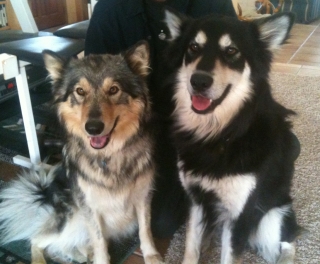
Some of you may already know about Sierra, the two-year old, mostly-keeshond-husky mix we adopted ten months ago from the shelter. What you may not know is that two months ago we adopted Bodhi, a year-and-a-half old male husky mix, also a shelter rescue (that's him on the right). He’d belonged to a college guy who couldn’t afford his upkeep, or so the story goes. My guess is that the poor guy returned to his dorm room one night to find Bodhi having a keg party, music blasting (Who Let the Dogs Out, of course), the room in shreds. Bodhi is easily the most destructive dog I’ve ever owned. And having owned wolves and wolfdogs, that’s saying a lot. Bodhi has eaten small items like a house phone and various paperback novels, as well as major appliances, like an outdoor mini-fridge. Although he’s not a young puppy, he obviously never learned house rules such as don’t grab things and eat them when someone isn’t watching you for all of two seconds.
There have been major issues in the two months we’ve had Bodhi: he and Sierra fought for the first two weeks, although there was no bloodshed during this “acclimation period.” They will, however, fight over resources to this day. It’s been a challenge to find chew items that can be left out that will entice Bodhi enough to chew on them, but not so high value that the dogs will fight over them. After much trial and error, I’ve learned that leaving plenty of antlers, clean, empty Kongs, Galileo bones, and Nylabones works. (I don’t normally recommend the latter two as they’re plastic—albeit the type that flakes in tiny pieces that easily pass through a dog’s digest tract—but in this case, I’ve made an exception.)
Having to get creative with chew items might have been thinking outside the box, but at least there was a box. Dealing with Bodhi’s pushiness is another story. Insecure, needy dogs often crave attention, and Bodhi is no exception. This, combined with his automatically wanting whatever Sierra has—in this case, attention—results in him bodily inserting himself into the midst of things whenever my husband or I reach to pet Sierra. Before Bodhi came, one of my favorite things was to pet Sierra to the point where she’d roll over for tummy rubs, her front legs sticking straight up, a grin on her face that’s as close to goofy as she gets. But that all changed with Bodhi’s arrival, as she didn’t feel safe in that position with him nearby. At first, I implemented a typical behavior modification scenario, where I had Bodhi down-stay on a dog bed while I petted her on the nearby couch, rewarding him periodically with treats for lying calmly. This worked, and it improved his behavior some, but it didn’t really solve the problem in other scenarios, like when they both rushed to greet my husband or me.
I started to think about the underlying reasons Bodhi acts the way he does. He’s in a new place, he’s insecure, and he’s anxious. (Okay, and he’s also just a pushy adolescent male, but I don’t have a magic wand for that.) If I could make him feel less anxious and more a part of the family, he might behave better. I have to admit that due to the fighting between the dogs, the destruction, Bodhi's on-leash dog reactivity, and a host of other issues, I had been wondering whether we’d made the right decision in adopting him. I’d felt at a loss to truly form a bond with him, which is highly unusual for me. Because of that, I’d been acting less lovingly than I would normally toward a furry family member. And so, I mounted a Cuddling Offensive. Yes, this was all-out war; that dog was going to get attention and cuddling until he submitted! Sure, I can hear you thinking, but a leadership program would have helped more. Check! One had been in place since day one, and although it had helped some with his manners (sitting and waiting for food is a huge deal for him, but he does it well now), it didn’t help with this. And just insisting on his staying out of things would have worked as well, but if I even raised my voice to correct him, Sierra, being the sensitive creature that she is, would cower. After a week or so of Operation Cuddle, the extra attention paid off. Bodhi visibly relaxed. It may be that my acting “as if” I felt more affectionately toward him helped too, in that it actually brought us closer together. Since Bodhi was now getting plenty of attention, it was no big deal for him to lie nearby while Sierra enjoyed her tummy rubs.
Another area where I used a different tactic than I normally would is with handling exercises. You probably already know that many resource guarders also have handling issues. In our southern California desert town we have plenty of foxtails—pointed, dried out, weedy growths that can be fatal if they work their way into a dog’s skin. At certain times of year, it’s critically important to be able to check between furry toes for them on a daily basis. When I first tried to do this with Bodhi, he didn’t bite, but he did place his large, strong jaws gently around my forearm as if to say, “I’d really rather you didn’t. Please, let's not take this to the next level.” Normally, with clients’ dogs (and even my own), I would incorporate classical conditioning in the form of gradual handling paired with food treats. Food works for Bodhi in a big way, but what I needed in this case was for him to lie calmly, and he’s so food-crazed that I didn’t think he’d be capable of that with food around. So once again, I completely changed tactics and instead just proceeded very slowly, using long, calm petting strokes paired with a soothing tone of voice, taking intermittent peeks between his toes. Over time, the teeth left my forearm as Bodhi realized that I was not going to hurt him or force him. Checking for foxtails is now much easier, and less stressful for both of us. We’re not at the point where he’s lying there happily as I clip nails or do something invasive, but it’s progress, and I can brush him out now as well, thanks to the same technique.
One more unorthodox tactic: because Bodhi seemed to feel the need to constantly grab things off tables, counters, and the floor (normally followed by chewing them), and I couldn’t (or didn’t want to) supervise 24-7, I laid out a row of empty Kongs and other hard rubber items on the top of the washing machine, one of his prime spots for grabbing things until we’d figured it out and stopped leaving dish towels and other items up there. Now when he’s unsupervised and feels the need to grab something, he puts his front paws up on the washing machine, grabs an empty Kong, and takes it outside. I know, it goes against traditional thinking to allow him to practice the bad behavior, and worse, to get rewarded for it. But I had to do something, and it worked. The argument could also be made that the unwanted behavior has effectively been directed and confined to an acceptable area, much as one creates a digging pit so a dog won’t dig up the whole yard.
Sometimes, when your back’s against the wall and the usual tools in your toolbox don’t fit the job at hand, you’ve just got to throw away the box and start from scratch. Maybe that’s a good thing for us trainers, as it keeps us on our toes. It's good for the dogs too, as a little creativity can make the difference between a loving, forever home and a dog who gets constantly bounced around or worse. Here's to throwing away the box.
- nicole wilde's blog
- login or register to post comments
- 4207 reads
- back to the dog blog
- more by nicole wilde


Individuality
I love reading about this. The best solutions are when we understand our dog's individuality and forget what might have worked for others in the past.
Throwing Away the Box
I love the photo of your dogs. Young Bodhi would fit right into my team if he were just a bit larger. Sierra would make a prime candidate.
Most of my sled dogs are rescues, and some came from pet homes where they were gratefully relinquished because they were "hyper and destructive". Today they are happily running up to 40 miles a day, limited by my own schedule as they are all quite capable of doing 80 to 100 mile days on the trail. This is NOT an exageration.
When someone aks me about a husky or husky mix that is "hyper" or "destructive", my first question is "How much are you running him?" The answer almost always falls into the "not nearly enough" category.
Huskies have been selectively bred for at least 4,000 years to run and pull. What folks might call a "husky mix" is the dog we mushers refer to as the Alaskan husky, dogs that are capable of running 25 to 30 miles at a fully suspended gallop or that can trot along averaging more than 100 miles per day for up to 10 days at a stretch.
The need to run and pull is so deeply ingrained in their DNA that a husky or husky mix that isn't given the opportunity to work goes a little bit crazy. OK, some of them go MORE than a little crazy.
A walk around the block on a leash, or even an hour of free-running in an open space just isn't going to cut it for dogs that were bred to pull a sled between 50 and 100 miles each and every day. For that reason, I highly recommend husky owners take up one of the dog-mushing sports. In warm climates with little snow bikejoring or scootering (mushing with a bicycle or kick scooter) is a great way to have fun while giving your husky the intrinsically rewarding exercise s/he craves. If you are also the atheletic type, then skatejoring (mushing with a skateboard or roller skates) may be the game for you.
Keep it short at first, until you and your dog have learned how to safely play the game and gotten back into shape. Build up time until your dog is maintaining a lope, trot or pace (the dog's preference) for at least an hour. If you have no choice but to run on pavement, be sure to use good quality dog booties, and expect to replace them regularly.
A tired husky is a well behaved husky, and once your dog is getting adequate exercise you'll find s/he can concentrate on controlling his or her own behavior much more readily. The opportunity to run is a HUGE life reward for these dogs, and one of my favorite rewards when doing behavior training is to release the dog to free-run laps around the kennel.
So, Nicole - how much are you runnin' them?
Swanny and the Stardander Historical Sled Dogs.
A good dog is so much a nobler beast than an indifferent man that one sometimes gladly exchanges the society of one for that of the other. William Francis Butler
Reply to Swanny
Hi Swanny,
Wouldn't it be nice if the answer to everything was that I just wasn't giving Bodhi enough exercise! Thanks for highlighting to others the need for huskies, husky mixes, and other active breeds to get enough physical exertion. We live in southern CA and although we can't exactly do snow mushing, we do urban mushing. Unfortunately, we are currently dependent on a friend's equipment for this and so are reliant on their schedule, but we do go whenever we can. Bodhi and Sierra are actually taken on separate exercise jaunts every morning. One goes with my husband and one goes with me. We believe in giving the dogs "alone time" with us individually and away from each other, and it's good for us too, as it gives us exercise. Bodhi normally gets off-leash time running at the park AND approximately a 45 minute to an hour walk around the trails of the park each time. He also gets mental stimulation at home in the form of short training sessions throughout the day, Kongs, etc. Hope that answers your question.
Nicole
going beyond training and into relationship
I really enjoyed this post. It's easier to think about standard solutions to typical problems. But relationship is about moving beyond that and seeing what your animal is really telling you.
I really hope you'll continue to share stories about Bodhi and Sierra.
Pamela http://www.somethingwagging.com
The question was intended to
The question was intended to be rhetorical, but I'm afraid it didn't come across that way. So sorry. I love that they get one on one time during exercise. It's something a lot of mushers don't put a lot of thought into, especially those with large kennels.
Swanny
A good dog is so much a nobler beast than an indifferent man that one sometimes gladly exchanges the society of one for that of the other. William Francis Butler
Thank you for telling us about your journey
I've been following your adventure with Sierra and Bhodi on your Wilde About Dogs blog: http://wildewmn.wordpress.com. Your story about your new rescue dogs is so important for owners and trainers to hear. Too often, we get caught up in doing what is "correct" with a dog instead of doing what is "right" for that dog (and family).
As always, you bring insight, humor and compassion to your work with dogs. Thank you for sharing with all of us. I look forward to hearing about your continuing saga.
Companion Animal Solutions Behavior Modification for Family Pets Scientific. Safe. Effective. http://companionanimalsolutions.com/blogs
Thanks all
Thanks all for the comments and kind words. And Christine, thanks for mentioning the Wilde About Dogs blog (http://wildewmn.wordpress.com). If anyone is interested in past stories of Sierra and Bodhi, you'll find plenty there.
Swanny, no offense taken. Interestingly, Bodhi's destruction really has been more related to anxiety than to exercise deficiency. Although he and Sierra are both high-energy dogs, thank goodness they're not quite as high-energy as pure huskies. (That was one of the reason we got mixed breeds.) But I do still think your info will be very helpful to many who read these comments. As to Bodhi, thankfully, after 2 1/2 months here he's finally relaxing, which has had a direct correlation to there being less destruction. It's been a very tough first two months but he's worth it, there's a great dog underneath all of that just waiting to shine.
Very helpful blog
Nicole, I loved your blog and description of what you are experiencing with Bodhi. Having adopted our 2nd dog about 6 mos. ago, I've often wondered, "what in the world was I thinking?" My female was perfect in my mind, sweet-tempered and mellow. Then came the hurricane, teenage male. Bodhi reminds me so much of my Domino. I am going to try your suggestion about the counter surfing as no matter how much stuff we remove, he always finds something to pull off, take into the living room and chew, the last being a container of pennies. He's eaten packets of orzo, rice, peanuts, dried apricots, and on and on. We are now diligent about removing all food, but he just finds something else despite chew toys being available.
The resource fighting is also interesting. My two, being bully breed types, sound like they are absolutely killing each other at times. They are easy to pull apart but when we are in public and they start to play like that, it is unsettling to other dog owners who do not understand. Like you stated, there has never been a mark on either one of them, but it sure sounds horrendous. The good thing is that my girl, whom I love with all my heart, is not a jealous dog and essentially shared everything with Dom from day 1, including the bed. Being that we are Dom's 3rd owners in his year to year and a half of life, he, too, exhibits jealousy traits, but mostly related to the kitties. We monitor that very closely and they are never left alone together when we are not home. He's gotten so much better, but it has been a long road.
Thanks again for a worthy, informative post. Makes me feel much better about taking on Domino and the extra work he's brought to our family life. He's a very affectionate boy who loves to be hugged and squeezed and petted and kissed. We can pretty much do anything to any part of his body and he was like that from the get-go. He gets along with all humans and dogs, except he's too exuberant and strong for some dogs, so I am careful about who he plays with. All in all, he's an awesome dog that just needed owners who understood his breed and the fact he had no training.
Thanks, Pit-Mix Mom
I love the way you put it: "...he's an awesome dog that just needed owners who understood his breed and the fact that he had no training." I think this sentiment applies to an unfortunate number of dogs who are adopted. If more people were breed-savvy, did training, and provided adequate amounts of exercise, these dogs would have a much better chance. It sounds as you're in the same boat as me with the sweet, mellow female you had and now your teenage boy Domino. I hope the counter surfing tip works for him. Hang in there, if we can live through their adolescence, they'll be great dogs!
Thank you, Nicole
I really enjoyed this blog. I love the "throwing away the box". I can really appreciate the title! I see trainers (and I try to watch myself as well) default to reaching for their "tool kit" or single method of training and inserting Treatment 'A' to address Problem 'B'. Really looking to the dog as an individual and all the variables involved, by being flexible, open and creative, you helped find solutions for both you and your dogs. Making it work for all of you is a great lesson!
Rewarding bad behaviour...
I like the suggestions regarding "rewarding bad behaviour" to condition acceptable behaviour a lot - it worked for one of my dogs, too. I had the same problem; Flakes would grab all kind of stuff from tables and counters and start chewing it or steal items to illicit a game of catch. So my husband and I started playing with him when he took certain acceptable things such as socks or even fruit from the fruit bowl and ignored the rest (although that cost us quite some nerves sometimes when instinct kicked in and made us want to save certain things). He now limits himself to such items we used to encourage and has even migrated to his own toys (imagine the party when he started doing that...).
Bettina Alfaro http://www.familienhundtraining.com