Sue McCabe's blog
March 5th, 2012 by Sue McCabe
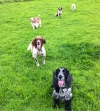
Some of you may have read my previous blogs on the challenges of owning an un-castrated teen dog. After much frustration at the beginning of February, & following advice from two training friends who both own un-castrated males, I’ve been working with Border Collie Guinness & his urges for over a month now. Nicked-named the ‘sex factor’ by one colleague, this is a great phrase to describe behaviours which often intensify during a testosterone surge, usually experienced by entire male dogs between the age of 7-15 months. ‘It’s a bit like your 14 year old locking himself in his bedroom with a dirty magazine’, she explained. The canine equivalent where Guinness was concerned included frantic leg cocking & urine marking, intensive sniffing, licking & salivating over other dog’s wee & leg humping.
January 30th, 2012 by Sue McCabe
There is one thing I tell my clients on a regular basis and this is to have a training plan. Don’t just blindly find yourself in situations where you’re supposed to be training your dog, without first thinking through the possibilities for distraction, reaction, reward, and an all important emergency get out clause, if things get too much for either you or the dog.
The challenge had been set, to get my teenage puppy Guinness to stop cocking his leg on everything and anything his testosterone filled body declared worth peeing on. You may all be pleased to hear that on day one, this exercise resulted in a major failure on my part. I would love to tell you all that as a trainer, I do everything one hundred percent correctly, one hundred per cent of the time. But of course I don’t. Last week was a great example of what can go wrong.
January 20th, 2012 by Sue McCabe
I am a huge advocate of neutering. It’s very difficult to find a dog person who comes from a rescue background as I do, who isn’t vehemently pro-neutering. Indeed, I generally advise clients that with a few exceptions, neutering will result in a dog who is easier to live with and healthier in the long term. So why did I make the choice to leave my current male dog intact for a year, when all my other dogs would have taken their trip to the vet for ‘the chop’ by now?
As a trainer who’s been around for quite a while, it’s easy to give the same old answers to the same old problems. This is especially true if those problems are likely to be solved by castration (humping, scent marking, some aggression issues, recall challenges around other dogs). Now what if the client in question is just as against castration as I am an advocate of it?
October 21st, 2011 by Sue McCabe
People, who know me, may have thought I’d lost my mind this week. I usually keep to myself on dog walks. I enjoy the tranquility with my own dogs to play & train, since I spend so much work time with other people & their dogs. This week I was seen to approach strangers, chat to the lollypop ladies, mount an empty bus & dance up and down the aisle several times & stand rattling a plastic sign in the wind for no apparent reason. We approached & chatted to other willing dog walkers, stood by two surfing dudes while they stretched & prepared their boards. I even discussed pneumatic drills with some hard hat clad work men. The final act leading to the questioning of my sanity was my appearance in the kitchen wearing a witch’s hat, a black wig, a scary mask & brandishing a broomstick.
October 11th, 2011 by Sue McCabe
One of the most important lessons to pass on to your dog is the meaning of the word ‘No’. Those of you who train positively, as I do, may be surprised at my focus on the negative. However, things may make more sense if I explain that the less your dog hears this magic word, the more of an impression it will actually have on his behaviour & his response to you.
The average pet dog owner often gets things quite muddled when teaching their dogs the basis of what they can & can’t do. An 8 week old puppy comes in the home full of willingness to learn. A veritable blank slate on which you, the owner must fill in the do’s & don’t of life. If we try to see the world from the puppy’s point of view it’s clear that what they learn, & what their owner is desperately trying to teach them, are often two very different things.
July 23rd, 2011 by Sue McCabe
We have a creature living in our garden. Several nights ago the dogs were all showing a lot of interest around the vegetable patch, an area usually out of bounds and not at all worth checking out as it’s boring. When I looked, I was surprised by a very large hedgehog who had sensibly retreated into a football sized spiky mass. Our garden is thoroughly enclosed with close panel fencing so the creature must have moved into the garden while small enough to fit through the fence and then enjoyed a feast big enough to grow and grow. No wonder the slugs haven’t been too bad this year.
July 3rd, 2011 by Sue McCabe
Never ask someone’s child to come up with a name for your dog. It’s a lose lose situation for all. The kid will declare confidently that ‘Frank’ is a good idea and you’ll have to find ways to let them down gently, that you disagree. Poor puppy-no-name will stand by hopefully, yet again feeling like he will remain nameless for the foreseeable future.
I ask a lot of my dogs. They are first and foremost beloved family members and pets. They are walking companions, stress relievers and fun times candidates. But they also need to be work colleagues, attend puppy class and help the newbies learn good body language. They need to demo at agility days, obedience classes, clicker tricks. Most importantly, they are usually trained up as stooges for dog aggression cases which I work with regularly. That’s a lot to expect from them.
May 5th, 2011 by Sue McCabe
In 2005, the world welcomed its first cloned canine-Snuppy the Afghan Hound. Great promises of replacements for our beloved pets, scientific breakthroughs in canine disease and research were all hailed as possible outcomes for the South Korean achievement.
For the lay man out there, it’s hard to understand exactly what goes on, but I’ll try to explain in very brief terms. DNA from the cell of the dog to be cloned is implanted into a donor egg. Somehow (details are beyond the average person’s understanding, including me), this DNA fuses with the egg and triggers embryo growth. The embryo is then implanted into a surrogate bitch producing a cloned puppy, born after normal gestation and whelping.
January 12th, 2011 by Sue McCabe
I made the decision last year to introduce the Kennel Club Good Citizen Puppy Foundation & Bronze level awards to my training classes. I’m certain that the basis is there for a great training idea in theory. Both levels teach basic manners, handling and life skills which should make living with your dog easier and allow you to enjoy each other’s company more. However, in practice, there are elements to the programme of both levels, but especially the Bronze Award, which make me wonder just how far we’ve actually come in dog training terms.
December 3rd, 2010 by Sue McCabe
Remove all distractions when training a young dog…even unexpected ones. I’ve heard myself tell clients this so many times. When starting off training a new puppy, or an older dog that is learning something new, make sure that the distraction levels are kept to a minimum. This allows your furry buddy to achieve success and confidence in learning. You can then begin to introduce low, and gradually higher levels of distraction as time goes on.
Dog Star Daily® Recomended Products:
-
DOGS BITE But Balloons and Slippers Are More Dangerous
-
AFTER You Get Your Puppy
-
Training the Companion Dog (set of 4)
-
Living with Wolfdogs: An Everyday Guide to a Lifetime Companionship, Second Edition (Wolf Hybrid Education)
|