Rethinking Dog Parks

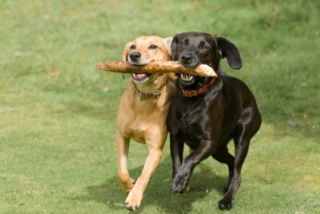
dogs retrieving together

My post last week on Dog Parks caused quite a stir, with 47 comments, a rather bizarre swipe of most of the post by someone who lacks the courtesy (or the courage?) to link to what he parodies, and more retweets than I could count.

The incident I had heard about on twitter that lead me to write the post also became a blog post itself.

A few people got caught up in the particulars of what I listed as potential problems, so let me summarize: my main objection is that oftentimes you don't know what you will encounter in a dog park.

Most of the people that disagree with me seem confident that they do know what they will find at their local parks. Since I offered, as alternatives to dog parks, ways to insure that you do know what you will get, this makes perfect sense to me. If you are lucky enough to live near a park that is predictable, that's great. I don't, and based on many of the comments I'm apparently not alone.

Many dog park proponents described concerned and conscientious people meeting at the park for managed playtimes. Others shared what I have witnessed: out of control play with inattentive owners.

In my area a dog park is a fenced area, usually part of a larger municipal park, that is set aside for dogs. It may or may not have separate entrances and exits. It may or may not have inner gates to prevent easy escapes and door-dashing. It tends to be quiet during weekdays and over capacity on evenings and weekends. It's a public park, which means anyone can go there with any dog and rules enforcement is irregular at best.

Maybe I painted dog parks with too broad a brush (and maybe a few people painted those of us who do not like dog parks with a similar brush...but I digress) based on my experiences of public dog parks at peak times. But the fact that I am seeing them at their most crowded times also likely means that what I see is what most people see.

Wandawoof described a members-only park in Illinois. That sounds great! As soon as a fee is introduced, you keep out the "poseurs" as Wanda put it. A membership also gives you an effective way to enforce the rules that a public park lacks. I pointed people toward day care and privately run playgroups for similar reasons: broadly speaking any fee, regardless of who charges it, weeds out many of the human bad actors, and a "velvet rope" gives the people running the place a way to be even more discriminating.

I never meant to say that all day care or training facilities are good - that's why I said that the facility should evaluate the dogs and allow you to observe what is going on. (It was in bold in the previous post too.) There are quite a few excellent day care facilities near me. Maybe that's a product of the lousy dog parks?

I also concluded with saying that playing with other dogs is not required for a dog to live a fulfilling life, right after I referred to dogs playing with people instead. It's interesting, and a little sad, how a few people latched onto the latter and let the former woosh right on by.

Many of the comments indicated that a more "productive" approach would be to tell people how to conduct themselves at dog parks, rather than just telling people to avoid them. But here's the problem: what do you do with someone who's dog doesn't belong there? Someone who leaves their dog unattended? Someone who just plain refuses to follow the rules? At what point does going to the park to have fun become going to the park to get annoyed (or be annoying)?


Stop Whining!

You posted a blog, based upon your admittedly limited geographical experience, about a controversial topic.  And, you got a number of responses that disagreed with your assesment.

In addtion, and on a larger canine-political landscape, you gave ammuntition to those who support breed legislation, closing dog friendly restaurants and outdoor events, and those who just don't like dogs.  And you did this based purely upon your limited experience with dog parks.

It must be nice to have a blog of your own where you can just start a new blog when people disagree with you.  Why not respond with the above in the original blog?

None of my critique means that you are not a knowledgeable, experienced dog trainer, whom I might recommend for other reasons. But, IMHO, you need to stop whining when others disagree with you, even if they are no more scientific than you are.

Chuck


"Train the dog you have in front of you...not the one you wished you had."

Dog parks

I have to agree with you Eric.  I always caution my clients about dog parks, specifically, because I have seen SO much damage done by them.  Frankly, when I comes to dog-to-dog aggression, dog parks keep me in business.  I see countless dogs who were dog-friendly until attacked at the local dog park by a dog someone was trying to 'socialize'.  I don't even count the injuries from dog parks that I have seen at the Vet's office while waiting with my own dog.  

Liz Catalano, MA, CPDT, CDBC www.thelittlewhitedog.com

As I commented on your previous post

Don't under estimate the power of human peer-pressure.

They key is having a group of regulars who enforce the rules, written or not.

When coming up to the owner who is the issue and talking with him/her doesn't do the trick (and many times it actually does work), simply leave.

As mentioned before, when a person sees the dog park "magically" empty when they arrive, they will pretty quickly learn it's not for them (negative punishment anyone?)

And yes, I do avoid the dog park on the weekends- because there too many "weekend only" people who come and don't really know how to handle thier dogs.

BTW, assuming that peak hours is want most owners see is misleading- one  doesn't really know if the number of owners that come at the limited peak hours is actually greater than the combined number of owners who come on off peak hours.

And I'm not quite sure why if you see a problem at peak hours you recommend to avoid the dog park completely, instead of recommending on going in non-peak hours.

@xslf - thank you for

@xslf - thank you for answering my questions.

Re: off peak vs. peak hours, that's part of my "rethinking." I guess more people (or at least more people that read this blog) can make it to the park off-peak than I thought. Of course, if everyone could, they wouldn't be off-peak hours anymore would they?

I suppose it's possible that the aggregate number of people visiting the park during the week is greater than the number of people that make it over the weekend. I'm just thinking that it's likely that most people have M-F, 9-5 jobs and are more likely to head to a park on a weekend.  

As far as negative punishment goes, the receiver of the stimulus decides whether or not it's punishment. If everyone clears out whenever (s)he shows up, who's being punished? How much fun is leaving every time this person shows up?

It also only works with a known quantity. A privately run or membership-only organization would have the ability to check the dog out in advance and/or introduce the new dog slowly and carefully.

I see the "group of regulars" as being similar to my suggestion of getting together with a group of people that you trust. And, as I said in the first post, if you can set that up at the park, that's just fine.

--------------------

Eric Goebelbecker

eric@dogspelledforward.com

Without going much in

to the psychology of the recipients of the "park empties when they arrive"- I know from my experience, and experience of others at other parks that it's pretty effective.

Think of it- how would you feel when every time that you arrive at a certain place everyone else leaves? It can be pretty offensive.

I do know about one case where one person called AC on another one who refused to go by the rules.

As for a known quantity- I don't know about those very large dog parks (after all, I writing from experience with some fairly small local dog parks. Even the one considered large here is tiny in comparison to some US parks), but at the parks I know, word of mouth travels fast. If a particular dog had an issue, most people there will hear about it within a few days.


Re: peak hours- I can tell from the two dog parks which are near where I live-

  • The tiny one that is open 24hrs- the peak hour is 6:30am, here many working people come. There is a smaller peak around noon when kids and their toy breed dogs tend to come for a mid-day outing. 
  • Other than that, the rest of the day it's pretty empty. With o more than 3 dogs at a time. There are significant times when it's completely empty.
  • The larger (and older) dog park in the area is open from 7am to 11pm.
  • It's peak is around 6pm. When people come there after work.
  • There are a few more regular groups that formed around 7am, 8am, and 10:30pm. 
  • There is almost always at least one dog there at other hours, but it's pretty quite.
  • During the weekend, most of the weekday regulars don't come, or come at different hours. There are no "peak hours" as such, but there are more dogs present throughout the day.
  • During school vacations, the peak hours tend to be less busy, since the hours of walking the dogs change when the kids are home and available.
  • During  summer and other hot days, at noon the dog parks are deserted- it is simply too hot here to take dogs out, and even dangerous to let them run around. My own dog refuses to go outside to use the toilet in summer noons, unless he is desperate.


From other dog parks I know (either personally or by knowing owners who go there), each one has it's unique temporal rhythm regarding on and off peak hours, summer vs. winter etc.  

Private parks

My husband and I own and operate a dog training club with off-leash park. We have been a training facility for 16 years, but allowed training clients to come hang out and work with their dogs. A few years ago, many of our clients started asking if their friends could come use the property as well. This set in motion the park as a part of the business. We spent some time traveling around to local public parks and watched how the facilities were used. We took note of what we liked and disliked about dog parks and came up with a list of criteria for members and rules for park members. We changed a few things around, added some accoutrements for park users and started allowing the general public to join the club for use of the park and clubhouse. Much to our surprise, we have thoroughly enjoyed the park and the members. We have learned so much from observing and monitoring a constantly changing pack of 75+ dogs ranging over 12 acres. There are great public parks out there, a strong community of involved dog owners is the secret and not always to come by. Of the local parks in our area, I know that 2 or 3 of them are well managed by a group of regulars and I don't hesitate to tell people to check those out if they are to far away from us or can't spend the money to pay for membership. Like anything else, there is good and bad and doing your homework is required.

www.wolfbrook.com


I get it

The very first dog park I went to  kind of spoiled me for life. It was small, contained, and populated by regulars who had NO problems enforcing the rules and asking people to leave if they or their pets were not behaving appropriately. I thought all dog parks were like that.

I talk to people on a regular basis about these things, and I've learned that in the area there are some good ones, some OK ones, and one or two that are just mass chaos- three separate people have observed small dogs being killed at the worst offender (a popular beach locale with an ever changing tourist population). 

It's about the people, not the dogs. I guess I have assumed that the type of person who would take the time to go to a dog park would automatically be the more responsible type to begin with, but it's not always the case. Had I not had the ability to talk to so many people, I wouldn't have known that certain locations were so bad compared to others. Thank you for a timely warning to be aware of the situation, and to keep your pet safe.

dog parks and appropriate meet and greets


If only ALL DOG OWNERS bought/watched atleast Turid Regaas's dvd http://www.youtube.com/watch?v=Lj7BWxC6iVs  on Calming signals...it goes over appropriate meet and greets, is short, easy to understand...

I used dogparks when I lived in the city as training opportunities, working on the outskirts and only walking through as a reward for playing and working on their cues. 

I learned really quickly that other owners most often didn't see any problem, with my guys, being most often the smallest in the park, being bulldozed and used as squeeky toys by their dogs.  As long as their dogs were happy, bouncing around, bulldozing others...my dogs were the ones with the problem.

I think this heated discussion was a great start on exploring what everyone people who frequent the parks to make it safer and educate others.  I hope you dive deeper into this issue!  Everyone brainstorming to make things better, share what helps in their areas, may actually lead to change :)

It drives me nuts to hear people use these terms to excuse their dog's bully behavoiur...my dog is a... top dog, alpha, dominant.. when they see their dog using pressure tactics on a dog to interact...

It is NOT actually fair or appropriate if the dog does not take into account the one they are trying to entice to play's body language...

Teaching people how to turn their bully into a charming benevolent, thoughtful, respectful dog is one way the dog parks will become safe for all to enjoy.

I actually just taught my dogs a cue to 'blow other dogs off politely" for times when owners ignore my request to "call your dog please".

Most of the time they're off leash in an on leash area, or they are coming at us without owner in sight, and I don't want to play leash twister (I walk with my 3 dogs).

Sometimes I can see from a mile away their dog is NOT going to be polite...this cue will hopefully take the pressure off my guys and allow us to be on our way without my guys or me having to be overt in asking the dog to leave us alone.  I don't think it's fair for my guys to be pushed to the point of being noisy, nor do I feel that it's appropriate for me to ask them to endure rude behaviour.

I hope this post leads to more discussion on something as simple as people learning how to reinforce polite behaviours in dogs...I think it would be a huge step in the right direction! 

cheers,

happy-houndz.blogspot.com

kate

Dog Parks

I have a Golden Retriever who (surprise, surprise) LOVES to swim. The first time I took him to the dog park, I slowly introduced him to the water. He quickly became obsessed with retrieving his floppy frisbee. He could spend hours swimming and retrieivng. While on dry land, he loves to be chased and rarely retrieves anything. At the lake, he is the perfect swimming retriever!

Unfortunately, he has no interest in playing with the other dogs. He is not aggressive towards other dogs; he simply prefers to swim and retrieve. It makes it very difficult to be at a dog park when a large percentage of owners are off socializing with each other rather than watching their dogs.

Since most dogs are at the park to socialize and play with each other, I have decided that the dog park is not the place for us. I believe I would be setting my dog and all other dogs up for an eventual "incident." So instead, I spray him with the hose in the safety of our backyard. He runs around like a maniac and "flosses" his teeth with the water. While he does love it, it doesn't compare to the joy, not to mention the great muscle building resistance exercise, he got from swimming in the lake.

I was required to provide a signed form from my vet showing that my dogs were UTD on shots and fecal tested. Maybe some day there will be proof of basic training requirements and for owners also!


Some common sense guidelines for dog parks

I'm not quite as anti-dog park as everyone else seems to be, but I do fully agree that visiting one always involves risk.

I only take two of my dog-walking client dogs to the park (separately) because they're the only two that I think are good candidates.

-They both are fully vaccinated and have no joint issues or other types of chronic pain.
-They both are well-socialized with people, children and other dogs.
-They both have excellent Recall and Leave-it commands, which I use to keep them away from the entry space and trouble in general.

To me, those are the bare minimum requirements for any dog to visit the dog park. Too many people bring dogs who should never be anywhere near a dog park! They appear to mistake the dog park for a training facility and create chaos while there. And they also unwittingly make their dogs' behavior problems far worse in the process!

The humans involved in this also bear a great deal of responsibility for what occurs at the park. The minimum requirements for the people at the park:

-Only bring one dog. I don't care how wonderful your dogs are. You'll be watching every single dog at the park and it's far too much responsibility to think you can control more than one of your own at the dog park while monitoring the rest of it.

-Be over ten years old. There is no place for small children at the dog park. Things happen too quickly and small children can easily be hurt by even friendly dogs engaged in boisterous play or chasing games. Children don't read dogs well and they are a distraction to the parent who unwisely brought them.

-Be reasonably fit. You need to be able to control your dog, possibly to break up an incident and be steady on your feet. Why I see seniors who need help walking to a bench at the dog park or owners carrying infants,  I'll never understand.

-You have to watch your own dog carefully and stay close to him. Things happen quickly and it's your responsibility to control your dog. You should also be a reasonable reader of dog body language so you can prevent incidents from occurring.

-You should have at least partially exercised your dog before you arrive at the park. Otherwise, he may be too excitable to safely use the dog park.

-You should make at least one lap around the outside of the park before entering. If you don't like what you see inside, don't enter. You also should be prepared to leave immediately if trouble starts.

-Similarly, you should keep an eye on the entry space. You can often spot the troublemakers (canine and human) right there.

- I try to go at the least busy times of the week and day. So do most other good owners and walkers. It's just safer as it's less busy and the more responsible dog owners also go at those times. I've also become familiar with most of the owners and dogs who use the dog park when I do, which also helps. And we talk to each other about the dogs we don't all know so we're prepared. If you see someone you know and trust leaving the park because a new dog is entering, you probably ought to go too.

If this sounds like the dog park is a lot of work instead of a relaxing way to kill a few hours with your dog, you're right! It is! If more people would put the work into dog park visits, we'd all have a better time in them. The dog park can be an asset if it's used properly, but often, it's used improperly.

Well said, 'KeepingAwake'

As I tried to allude to in the original thread, we easily wail and bemoan the irresponsibility of 'other' dog owners.  It seems to me, that in most situations, if we have control of our own dogs, we need not be overly concerned about the 'other' owner.

I own a Chesapeake Bay Retriever.  Heard of them?  Stubborn, hardheaded, with a tendency to be aggressive?  My Chessie was taken to dog parks precisely because he was showing fear aggression because of his early development in a rural southern environment. By the way, the stereotype is non-sense in my experience.

But, before he set foot into a dog park, he was solid as a rock in obedience.  I could recall him from, or out of, any situation he encountered.

He is my 'demo' dog now for all my group classes, and has met, quite literally, thousands of dogs in that endeavor and in his field training, and is an invaluable aid in assesing the behavior of what I call 'dogs with baggage'. He has saved my bacon more than once.

So, where did  he develope his social skills?  A lot of that occured in a dog park. 

Yes, I saw owners who had not a clue.  Yes, I saw dogs that I pegged as trouble from a great distance.  And, yes, there are owners who are ig-norant... that is they ignore the truth in front of them (even when you point it out) and refuse to be educated. But, regulars at the dog park love to see my dog and I arrive because they know my dog will act as a mediator, intervening for the bullied and inviting the bullies to play - rather than fight.

This could not be without a dog park!  There just aren't enough dogs around otherwise.

Chuck

"Train the dog you have in front of you...not the one you wished you had."

I am a member at a local

I am a member at a local members only park that I use infrequently. My dog could care less either way about playing with the other dogs, so when I use it, I try to go at the off peak times so he can run around by himself and fetch his ball. He doesn't mind the other dogs, he'll play with them, or will ignore them, but I know what he prefers. We had to go through some training in order to keep the membership, but I find it mostly useless. I already knew it because I have gone to good private training places. Others disregard it, bring in dogs on prongs, and have generally menacing dogs.

I might suggest looking for or starting a group on meetup.com. I found one recently that gets together to walk in the park. Some walk off leash, others stay on. The dogs mostly stay with their owners, but at certain parts of the walk some dogs will play. I've been going for a few months, and I have yet to see an aggressive dog in the group. There are some who aren't as friendly as mine who would accept any other dog and goes bouncing up to every person he meets, but the owners are good about letting others know about what their dogs are ok with, and others are good about making sure their dogs don't breach boundaries.  There is one in particular who is obsessed with my dog. Mine doesn't really care too much about it, but others would for sure. She keeps her dog at the front, and I keep mine behind him. There ranges between 5-15 dogs regularly, and the people keep pretty on top of things and don't allow minor things to escalate.

I'll never go

Today i was walking my 5 month old through a local park (Not a dog park, a school yard, that people often let dogs off leash) 

As i was approaching the group a dog came running out to greet mine (so we are a distance from his owner, who doesnt come to join) they start to play when all of a sudden the other dog gets aggressive and is on top of Summit snarling, i had to scream at the owner to get their dog, which seemed to be an eternity. 

He had zero recall on both this dog, and his gentle elderly dog.

The worst part was, they thought i was the crazy one and didnt feel anything was abnormal about the "play" 

Maybe if they werent so far away they would have seen the aggression in their dog, and the scared look on mine.

This was at a park with a total of 4 dogs. I will never increase the risk by going to a park where there is more

Pros, cons, and dealing with the cons.

I have a seven-month-old shiba inu that has been rigorously socialized at dog parks since he was four months old and a puppy class before that. Seeing other shibas at a recent dog-show has affirmed the benefit of hours at our local dog parks. The majority of the 200+ dogs my pup has met have been friendly. Several weeks ago, however, my little guy was surrounded and attacked by two dogs as he entered the only off-leash park in our area. There was no obvious physical damage and we rushed him off to the other side of the park while the owners of the other dogs held their dogs at bay. He was obviously traumatized and we’ve been diligently working with him since to negate the incident. He has been doing quite well and plays with nearly any dog that is willing (I plea for advice below if anyone cares to offer some). To some extent my dog is at dog parks to help socialize other dogs just as much as they are to socialize him. It is also one of the few places we can offer advice or trainers to people with behavior problems.

I’ll be contacting a trainer we’ve worked with in the past but I was disappointed that I couldn’t find any suggestions for how to deal with my specific issue online. Any advice or literature would be appreciated. Perhaps a description of my guy’s issues is in order.

He occasionally overreacts in a few situations: One, when he is surrounded by a group of dogs he begins to show uncharacteristic uneasiness that has lead to spats of vicious barking; two, when he has chosen a playmate he will sometimes greet newcomers with unfriendly barking (he rarely barks otherwise); three, after an intact male was a bit nasty to him he was equally nasty back, only to perpetually go back to the dog (that was humping another dog) to start trouble; four, and most bizarre, is that he tends to be unfriendly with huskies—there was a husky around him when the incident occurred but it was a black chow and brown lab that attacked him. It isn’t horribly consistent, but today he was quite unfriendly to two huskies after greeting some twenty other dogs. He was fine with the dogs he met afterwards. He has reacted poorly toward two other huskies and positively to several others, including the one that was around the day of his attack. Today’s incident was perplexing as he jumped on the first husky’s back, as he commonly does when he is playing with a larger dog, paused, then proceeded to growl viciously at him/her—while still on his/her back.

Well, I’ve rambled on. Thanks for those who took the time to read it. I appreciate any suggestions!

Tentative Observations

Jeremiah,

I am reticent to offer advice over the internet without actually having observed your dog and the situations you are describing.  And, my post here, certainly changes the direction of this blog.  So, apologies in advance for ‘hijacking’ just a little bit.  What I can offer is some observations that may be useful to you for determining what I believe to be your hoped for strategy of having your dog return to his previous  social behavior toward all dogs.  Additional apologies for telling you things you may already know and have considered.

First...the place.  (Shilke 2003) and (Shalke 2007) showed that dogs returned to a place where aversives were previously encountered (Shilke, behavioral, and Shalke, cortisol levels) displayed fearful/avoidance behavior, and elevated cortisol levels respectively long after the aversive was removed.  In other words, returning to a place where aversives were experienced produced the same behavioral and physiological effects as the original experimental situation.   This suggests that dogs generalize more than the behavior of specific dogs, or species of dogs, but also includes the place where the aversive occurred.

Secondly, ... breed.  I’m going to replace ‘breed’ with ‘phenotype’ here because your dog may be hyper-generalizing to a dog’s outward appearance rather than to a breed.  If you look at the totality of breed, ‘Chow –vs – Husky’ there are certainly differences.  But, from your dog’s point of view, not being aware of ‘breed’, the physical appearance of both may be similar enough to evoke a negative association with Huskies based purely on phenotypically similar appearances.  Change the coat color, and you have phenotypically similar dogs in appearance.  Have you had the opportunity to observe whether your dog responds similarly to other ‘Chows’ as he does with ‘Huskies’?

These two observations (if accurate) may suggest a strategy for 1) not placing the dog into an environment he considers aversive, at least for a time, and 2) – directing your efforts to re-socialize your dog to individuals that are phenotypically similar to Chows or Huskies.

Caveat Lector

Chuck


"Train the dog you have in front of you...not the one you wished you had."

Dog Star Daily® Recomended Products:

  • For the Love of a Dog: Understanding Emotion in You and Your Best Friend cover image
    For the Love of a Dog: Understanding Emotion in You and Your Best Friend
     
  • Parenting Your Dog cover image
    Parenting Your Dog
     
  • Your Outta Control Puppy: How to Turn Your Precocious Pup Into a Perfect Pet cover image
    Your Outta Control Puppy
     
  • Kong Large Biscuit Ball cover image
    Kong Large Biscuit Ball