
He's just scared...but he would NEVER bite...
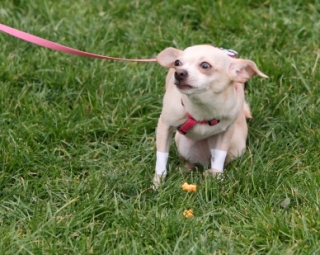
“He’s Just scared, but he would never bite.”

I overheard a woman say this at a recent dog-themed event at a local children’s museum. The dog was a young, male boxer who was terrified about everything happening around him. I had met him a few minutes earlier. He backed away from all who approached him. His whole rump was tucked under his hind legs, his ears were back and his head was as low as he could manage. His eyes were wide open and his mouth tightly closed. I turned away from him, crouched, dropped a few treats and he would not eat them. He WAS scared, and his new mom told me that she had recently rescued him. He was obviously malnourished, and I commented about how he was frightened with all the activity. She agreed as she looked over the various materials on my table. “You’re a dog trainer?” she asked. She went on to tell me about her other dog who was a “terror,” pulling on leash and stealing food from her children. I spoke with her for a few moments and gave her a sheet of tips for common challenging behaviors with my contact information on the top. She moved on...

A few minutes later I noticed her about two booths away from me. She was now holding two leashes and was tangled up with her dogs. I went over and helped her untangle the leashes and held the leash of the other dog, an adolescent male lab-mix, until her husband came over and took hold of him. I had him sitting for treats and got the boxer interested a little in what was going on. He sniffed and wiggled his tail-stump a little, but still would not take the treats. As her husband walked to the next booth with the lab, I watched the boxer clinging to his owner’s side like there was a magnet beneath his skin and she was a refrigerator.

I noticed a toddler quickly walking toward this terrified boxer, and watched the boxer try to hide behind his mom. She pulled him out from behind her as the toddler reached for his face. I cringed and just as I was about to step in, the toddler’s father came up behind her and asked if it was okay that she was petting the dog. The boxer’s owner said, “He’s just scared, but he would never bite.” At that moment the toddler, a girl of about two years old, brought her other arm up to give this puppy a kiss on the face. I instinctively plunged my arm between them and moved the girl away. I apologized to both the girl’s dad and the dog’s mom. I could not allow that interaction to continue. I moved the boxer and his owner to a quiet corner and repeated to her that her dog was scared. She agreed. I went on to explain that he was trying to hide, and she was telling him that he couldn’t hide by pulling him back out from behind her. She agreed. I asked her if she realized that there are only two ways out of fear: flight or fight. Her face went pale and her jaw dropped. I continued, her dog was clearly trying to flee, and she was telling him that it wasn’t going to work. That leaves him with one option to escape his fear...

She quietly said, “fight?”

Just because your dog has never bitten, does not mean he would never bite. In fact, biting is a very normal behavior, and ANY dog, in fact EVERY dog WILL bite given the perfect set of circumstances. I wish I had a dollar for every time a new client told me their dog had never bitten anyone before. They never do, until they do.

If you know your dog is afraid, you need to find ways to distract him; give him something else to do, something else to think about. Have him sit and look at you, teach him to hide behind you on cue, move him further away or just go home. Do not try to make him get used to it and NEVER force him to allow someone new to pet him. Teach your dog to “touch” your hand on cue, and then tell people to hold their hand for him to “touch” as a greeting. And also tell people to not reach for him, allow him to initiate petting, if he chooses.

Parents, teach your children to never, ever pet a dog unless the dog “asks” to be pet by approaching and offering himself for petting. Do not accept any owner’s word that their dog will never bite. Never reach toward a dog who is trying to hide. And never, ever try to hug or kiss a dog, not even one that you know.

Be safe.

 

Preaching to the choir!

Recently on a park outing with my one year old daughter, a woman with two pom-chis came over and, in seeing my daughter's interest in her dogs promptly picked one up and put it in my daughter's face so she could "pet" it. Scared the crap out of me! Knee jerk reaction was to put my arm between the dog and my daughter and tell the woman to put her dog down. "He loves kids! He would never do anything bad!" was her response to my (from her point of view) overreaction.

The fact of the matter is that every dog CAN bite, and that every dog CAN be driven to bite. Her dog was not thrilled at being put near a child, tolerating it, yes... but I didn't know the dog and I didn't know his owner so why on earth would I allow that interaction  to continue?!

Fabulous article and I hope that more owners are able to realize that a great recipe for a bite involves fear and to take their dog's fear/stress signals seriously. Thank you, thank you, THANK YOU!

Very well said.  And even

Very well said.  And even more importantly....very well done!

Tired of hearing about how "all" dogs will bite

Sorry, but I have some dogs where the liklihood of their biting is less than the likihood that I am going to bite.

Did I work with bite inhibition when they were babies? Yes. Did I socialize them to almost every weird thing they ever could encounter. Yes. I have an apartment in San Francisco. Took about an hour there. Do I work with their mouthes regularly? Do I management potentially fearful situations? Yes Yes and double yes. AND I know their genetic predispotion back for 20 generations.

Not all my dogs, but a lot of my dogs.

Don't we need to disclose what it takes to have nice dogs that are less likely to bite?

Arnie might actually have a heart attack before he would choose to bite.

Some dogs have very high bite thresholds, and have mouths and jaws that are not conducive to bites that are going to do a lot of harm. Especially when they have all the above on board. So you guys can use this to defend breeds like the one that attacked my dad and my golden when I was a kid and cause extreme damage, but don't be looking for Arnie or Cissie basset to bite anyone anytime soon.

Sara A. Watson, CTC
Bluefence Bassets
APDT Member
Basset Hound Club of America
Northern California Basset Hound Club
Basset Hound Club of Sacramento
Golden Gate Basset Rescue

Great post, Michelle!  I'm

Great post, Michelle!  I'm glad the Boxer's owner at least got it quickly.  It's amazing how difficult it can be to get some people to accept that a dog can only take so much. 

I believe all dogs MAY have the capacity to bite

saraberry, I love Basset hounds and in fact have three friends who own them. For the most part they are the greatest dogs in the world, but as a hiker/outdoorsperson they at this point in my life would not fit my lifestyle. However, one of my friends had to re-home her basset after she had her daughter as he acted very aggressively towards her daughter, growling and snapping. So in my opinion, it is simply best not to trust any breed of dog around children or assume they will never bite. 

I do the same things you listed with my dogs as far as bite inhibition, socializing, etc. In fact, the nose touch game is one of the first games my trainer taught me and my female dog. To this day, I see the benefit of the game. I also mirror your assertion that my dogs' likelihood of biting is less than me biting someone. However, that doesn't mean that I assume all dog owners have done the same training regimen, regardless of breed. One of the friends who owns her rescued Basset is a veterinarian. She would never say that you should trust any dog 100% not to bite under certain circumstances. I guess I am confused as to what your message is meant to convey.

I think this is a great blog and very informative about owners who innocently do not understand their dogs' stress signs and what can happen in a chaotic setting for a dog that is stressed. The lesson here is not about breed, it's about the potential for an incident and a tool to keep in mind when in public with your dogs and how to discern problems that might arise with other people's dogs and how to educate about dog behavior. I admire anyone who would step in (trainer or layperson) to avoid a situation rather than take the "wait and see" attitude. That takes guts because many owners are not open to unsolicited advice. I have another friend with a rescue dog that is fear-aggressive so this situation really hit home. My friend is ultra-responsible so her dog would never be in this situation. He lives a wonderful life with her in a safe environment with daily runs on a private family property of 25 acres. One of my dogs is his best friend; the other has never met him and most likely won't. 

I think the moral here is that not everyone has the ability to choose a pedigreed dog with solid genetics over years and years of breeding. Many people who adopt dogs from a shelter do not have the benefit of knowing the history of the dog's training, socialization, parents or even what their dog is really mixed with. This blog just makes good sense as an educational tool to me as a dog owner who takes her dogs out in public almost every day, nothing more or less.

Love this article

Same issue I see reglarly with the same potential outcomes. Great article and great advice.  People just don't know enough about what fear in dogs can do and how to handle it, so thanks for helping educate them.  Although I own Staffies and an AmStaff cross rescue, I too believe all dogs can be dangerous.  I have worked for years training fearful dogs not ot be afraid, building confidence with lots of succecss and reward.  Cheers to positive dog training, the only good way to safety with fearful dogs.

What are the bite stages? I heard Ian talk about this.

Hi Michelle. Excellent post. Most people have no understanding of a dog's potential to bite and you layed out this scenario out very clearly. My husband and I went to Ian Dunbar's seminar in Burlingame in 2010. One thing he talked about in the lecture were the various stages of biting. I believe he started from Stage 0 up to 4 or 5. I took notes and unfortunately lost my notes. Does Dog Star Daily have that information? Thanks

Bite Levels

Janet,

Here you go:  Dr. Dunbar's "Bite Levels"

Level 1. Obnoxious or aggressive behavior but no skin-contact by teeth. Level 2. Skin-contact by teeth but no skin-puncture. Level 3. One to four punctures from a single bite with no puncture deeper than half the lengthof the dog’s canine teeth Level 4. One to four punctures from a single bite with at least one puncture deeper than half the length of the dog’s canine teeth. Level 5. Multiple-bite incident with at least two Level 4 bites or multiple-attack incident with at least one Level 4 bite in each. Level 6. Victim dead.

Dog Star Daily® Recomended Products:

  • Dog Aggression: Biting (VIDEO)
    Dog Aggression: Biting (VIDEO)
     
  • Getting a Grip on Aggression Cases: Practical Considerations for Dog Trainers
    Getting a Grip on Aggression Cases: Practical Considerations for Dog Trainers
     
  • One on One: A Dog Trainer's Guide to Private Training
    One on One: A Dog Trainer's Guide to Private Training
     
  • The Culture Clash
    The Culture Clash