
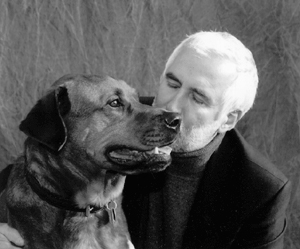
Dr. Ian Dunbar
Dr. Ian Dunbar is a veterinarian, animal behaviorist, and writer. He received his veterinary degree and a Special Honors degree in Physiology & Biochemistry from the Royal Veterinary College (London University) and a doctorate in animal behavior from the Psychology Department at the University of California in Berkeley, where he spent ten years researching olfactory communication, the development of hierarchical social behavior, and aggression in domestic dogs.
Dr. Dunbar is a member of the Royal College of Veterinary Surgeons, the International Society for Applied Ethology, the American Veterinary Society of Animal Behavior, the California Veterinary Medical Association, the Sierra Veterinary Medical Association, and the Association of Pet Dog Trainers (which he founded).
Dr. Dunbar joined the Society for Veterinary Ethology (now the International Society for Applied Ethology) over 35 years ago, at which time he was the only member specializing in dog and cat behavior problems. Later he was involved in the establishment of the American SVE (now the American Veterinary Society of Animal Behavior).
He has written numerous books, including How To Teach A New Dog Old Tricks, the Good Little Dog Book and a series of Behavior Booklets—separate educational booklets on each of the most common pet behavior problems. Additionally, he has hosted eleven videotapes on puppy/dog behavior and training, including SIRIUS® Puppy Training, Training Dogs With Dunbar and Every Picture Tells A Story. All of his videos have won a variety of awards. The famous SIRIUS Puppy Training video (the first dog training video ever produced) remains the all-time best selling dog video. For three years running the SIRIUS® video has always been voted the #1 BEST DOG TRAINING VIDEO by the Association of Pet Dog trainers-the largest and most influential association of dog trainers in the world. His books and DVDs can be found at: James and Kenneth
Before SIRIUS® Puppy Training Classes there were simply no puppy classes-Dr. Dunbar developed them in 1981.
Certainly, the SIRIUS® Puppy Training video had a dramatic influence on the pet dog fancy, completely changing the way dogs are trained in a number of countries around the world. Dr. Dunbar’s unique lure/reward, off-leash training techniques provided a delightful alternative to inane and inhumane leash jerking. In a sense, SIRIUS took the jerks out of training. SIRIUS techniques have been adopted and adapted by most thinking and caring dog trainers worldwide. For more information go to: Sirius Puppy Training
Dr. Dunbar was invited to develop and write (for over seven years) the American Kennel Club's Gazette "Behavior" column, which was voted Best Dog Column for a number of years in succession by the Dog Writers' Association of America.
In 1993, Dr. Dunbar founded the Association of Pet Dog Trainers (APDT) APDT in the United States and organized the first two Annual Conferences. Dr. Dunbar's current project is the creation of the K9 GAMES®-an exciting spectator event featuring fast-moving, motivating, competitive games for dogs and owners.
He has been lecturing to veterinarians and dog clubs for over thirty years. In fact, since 1986 he has conducted over 800 days of seminar and workshop for trainers and veterinarians around the world. There are very few educated trainers who have not been strongly influenced by Dr. Dunbar's fun & games, from-the-animal's-point-of-view, dog friendly dog training.
Dr. Dunbar is peerless in his field; there is simply no other person who has his qualifications, experience, and expertise in the realm of modern psychological dog training and behavior counseling-fields which Dr. Dunbar has played a major role in developing over the past 25 years.
Dr. Dunbar's books, CDs and DVDs are available from the DogStarDaily online digital store.
Also, many of Dr. Dunbar's multi-day seminars for dog trainers and
veterinarians are available on DVD from Tawzer Dog Videos, and
his "Give Them A Scalpet and They Will Dissect A Kiss: Dog Training
Past, Present and Future" lecture is available from Dogwise.

Dr. Dunbar's Upcoming Seminars & Appearances
January 25th, 2010 by Dr. Ian Dunbar
Jamie got married this weekend. Whooooo Hooo! Kelly and I are so happy and we both had the most marvelous time. The wedding was simply wonderful. And so, why am I blogging about this? Well, aside from being happy, happy, happy … the entire staff of Dog Star Daily was in attendance. Yes, Kelly and I and of course, our very own VP for Media & Marketing — Jamie. The celebrations lasted for days — from Thursday until Monday and relatives stayed on for days. But now my sister has left for Wales my brother just flew back to England. So, we are utterly exhausted and it is reeeeally difficult to get back to work. But, get back to work we must. We have a two-year US Seminar Tour to plan.
January 5th, 2010 by Dr. Ian Dunbar
Thanks to the Association of Pet Dog Trainers, January is National Train Your Dog Month .
We have special days and weeks and months to draw attention to a particular cause that is in dire need for attention. Of course, obviously, Train Your Dog Month should be every month of the year but what puzzles me, is: Why on earth do we feel that we have to draw attention to something as enjoyable and captivating as dog training? Isn’t that like promoting chocolate? Why does dog training need promoting?
December 28th, 2009 by Dr. Ian Dunbar
Since I have fallen hopelessly behind in my blogging quota, our esteemed editor has asked me to blog-post my last update on my Facebook profile, which turned out to be more of a three-installment blog than a status. Brevity is not my strong suit, that’s why I don’t Tweet!
Here it is...
December 15th, 2009 by Dr. Ian Dunbar
I recently read — How Puppy Class Almost Ruined My Dad’s New Cattle Dog — written by a veterinarian, who blames Puppy Class (and her Dad) for almost ruining her Dad’s puppy, Lucy. I am worried that the sensational and provocative title along with the tabloid style, (replete with “videotaped evidence”, watching “in horror” and the predictable cliff-hanger ending, “To find out what happened, stay tuned for upcoming blogs”), might lead unsuspecting puppy owners to believe that puppy classes are bad news. Consequently, I have decided to reply at length, so that owners realize why they should never let their puppy miss the opportunity of attending classes.
December 9th, 2009 by Dr. Ian Dunbar
Recently, I read a blog that upset me — Lunch with Turid Rugas: Am I Driving My Dog Crazy, written by an obviously intelligent and caring dog owner, who blames herself for the unlikely likelihood that she ruined her dog Sadie with too much early socialization. My heart goes out to the author and Sadie and I feel that I must respond in case people misinterpret the facts to mean that early socialization can be damaging.
September 30th, 2009 by Dr. Ian Dunbar
This year, I have resumed giving multi-day seminars in the States. During the course of my protracted (ten-year) retirement from the US seminar circuit, I gave my very first last multi-day seminar in Orlando way back in 2001. Between 1998 and 2008, I gave only five multi-day seminars — three of them in Orlando and each one billed as my very last and final US retirement seminar. But now I’m back…
Between1986 and 1997, I gave hundreds of dog behavior and training seminars all over the States and around the world. During that decade, I averaged over 200 nights a year in hotels. The schedule was a bit grueling and my pets at the time, Phoenix, Oso, and Mittens thought I was a stranger.
August 28th, 2009 by Dr. Ian Dunbar
I find that the non-aversive punishment technique that I described in my last blog works even better if you signal to the dog the relative urgency and importance of your instructions.
August 26th, 2009 by Dr. Ian Dunbar
Even though efficient and effective feed-back is binary and comprises rewards and punishments, few trainers punish. Some trainers do not want to punish at all because they think that punishments are unpleasant and inhumane and other trainers use aversive stimuli intended as punishment but all too often, ineffective. It is assumed that all punishments are aversive and that all aversive stimuli are punishing. However, neither of these assumptions is true. Once we realize that “punishment” and “aversive” are not necessarily synonymous, we realize we have four combinations. 1. Non-Aversive and Non-Punishing 2. Aversive and Non-Punishing 3. Aversive and Punishing 4. Non-Aversive and Punishing
June 14th, 2009 by Dr. Ian Dunbar
We live with three dogs, Claude, Dune, and Hugo, and two cats, Uggs and Mayhem. Most activities are fairly routine and deviate very little from day to day. For example, each mealtime is a well-rehearsed three-dog, two-cat, three-human performance.
Similarly, the dogs' morning walks usually follow a prescribed schedule — but with one big difference. The dogs are sometimes walked together, but my wife Kelly tries her best to also walk each of the three dogs individually at least once a day. After all, each dog walks differently. The dogs walk at different speeds, for different distances, and have very different interests and abilities while walking.
American Bulldog Dune yearns for really long power walks with occasional short breaks for heavy-duty peeing. For Dune, the purpose of the walk is physical exercise — to move and to move quickly – and to leave reminders for those who come after that he was there first.
May 25th, 2009 by Dr. Ian Dunbar
“Words can only hurt you if you try to read them.” (Derek Zoolander) Or, of course, if arguing about words detracts from training dogs.
Having researched the development of domestic dog social systems for ten years, I know two things for certain: 1. Dog social structure is pretty darn complicated and 2. Most notions, discussions, and disagreements about the terms: alpha, dominance, hierarchy, rank and aggression are all largely irrelevant when it comes to training dogs. Moreover, moot debate, banter and badinage only delays us from training dogs.
|