
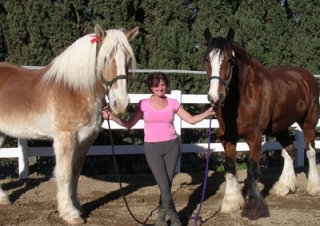
Valerie Pollard
Valerie Pollard has been training dogs professionally since 1979, and specializes in working with behavior issues, including fear, anxiety and aggression. She has always had a keen interest in learning and has hosted seminars regularly with international trainers/behaviorists in that regard. Valerie has a degree in Art History from U.C.L.A. and has completed coursework for the Master’s thesis – but left the program to pursue working with dogs.
Valerie believes that competing with your dog in any sort of venue can only enhance the relationship, whether it be AKC Obedience, Rally-O, Agility or Flyball. She has competed with her own dogs in the sport of Schutzhund, and attained the owner/handler Schutzhund III title with her GSD “Bodie”. She is also interested in British Working Trials as well as the Puppydog Allstar K9 Games as other challenging and fun ways to compete.
Valerie is a charter member of the Association of Pet Dog Trainers, a Clinical member of the International Association of Dog Behavior Counselors and endorsed by the National Association of Dog Obedience Instructors. Valerie prefers to think of animals in the following way, as described by Henry Beston in “The Outermost House”:
"We need another and a wiser and perhaps a more mythical concept of animals.....we patronize them for their incompleteness, for their tragic fate of having taken form so far below ourselves. And therein we err, and greatly err. For the animal shall not be measured by man. In a world older and more complete than ours they move finished and complete, gifted with extensions of the senses we have lost or never attained, living by voices we shall never hear. They are not brethren, they are not underlings; they are other nations, caught with ourselves in the net of life and time, follow prisoners of the splendor and travail of the earth."

More by Valerie Pollard
April 23rd, 2007 by Valerie Pollard
The woman on the other end of the telephone line was nearly in tears as she explained the terrible time she was having with her dog. He was “attacking” her, she said, and wouldn’t let her put him outside. She couldn’t get him out of the back seat of the car if she took him for a ride, her clothes were ripped and she had bite marks and bruises on her hands and arms. He was also “attacking” her three –year- old daughter, and she was worried for her child’s safety. Imagine my surprise when she then told me we were di
April 28th, 2007 by Valerie Pollard
“We need to you come over right away! Missy is trying to bite us!” The elderly woman’s voice was tight with distress on the other end of the telephone line. This was a totally unexpected call, because Missy was the friendliest, most submissive Golden Retriever you could ever meet; the type who came up to greet you with her rear end wiggling and tucked in, head sideways and licking the air, all aglow at the prospect of getting some attention and petting from everyone around her.
June 1st, 2007 by Valerie Pollard
The Alaskan Pug
First, it’s important to explain the differences between the Alaskan pug and the normal pet variety. The Pug dates originally to 400 B.C., was once the pet of Tibetan monks, and flourished in the sixteenth century as a lap dog. Since the temperament and personality of the Pug is already tenacious, brilliant, devilish, competitive and hardy, people began to dream of using the Pug to compete in various canine sports. Therefore, towards the end of the nineteenth century, breeders began deliberately enhancing certain traits in their litters to establish performance characteristics. Soon there were Pugs competing in protection sports, agility, police work and dog sledding, among other things. Thus: The Alaskan Pug.
July 26th, 2007 by Valerie Pollard
What methods do you use…relatively few prospective clients ask this, and when they do you can’t be certain exactly what they are hoping for. When an owner asks me, “what methods do you use?” – I ask back, “how much experience do you have with dog training, and what are your goals with your dog?” Some think they want harsh methods to ensure an “obedient” dog; some want reassurance that a gentle method will be used while others want to do the training “just like I did with my first dog twenty-five years ago”. However, the training of dogs has changed dramatically in the last twenty years, along with the perception of a dog’s place in the home, and the standards of training itself.
Clickers, steel slip chains, prong collars, no-pull harnesses….dog whisperers, communicators, leaders, companions. What’s an owner to do?
August 28th, 2007 by Valerie Pollard
Many people think that Dr. Laura Schlesinger gets a little insensitive and irritable with her callers. I’ve thought it myself at times when listening to her, but then I remember what it must be like from her point of view to speak with one person after another, to give them a thoughtful reply and then to have them disregard what she has said and move on to another topic.
One of the things that come along with being a dog trainer is the responsibility of answering inquiring telephone calls from prospective clients. Many trainers put a time limit on how long they will talk, “Never stay on the phone for more than two minutes”. Many will not answer behavioral questions, “Never give away free advice”. And many, like myself, prefer to discuss the issues so that we can understand how we may help and also perhaps give some immediate help to the unseen dog who lives on the other end of the telephone.
October 15th, 2007 by Valerie Pollard
“No, you don’t understand. I have done *everything*, my dog knows what she is supposed to do but she’s mad at me so she’s going to the bathroom in the house. I take her outside for half an hour and she just stands there and as soon as we come back in the house, she goes on the carpet!
January 10th, 2008 by Valerie Pollard
“..I spoke with the behaviorist my vet recommended, and then I spoke with a local behaviorist that my neighbor told me about…”, the woman explained as we spoke on the telephone regarding her aggressive dog who had now bitten two people, requiring stitches in both cases. I nearly literally began to grind my teeth in frustration at the sound of that overly and misused term, “behaviorist”. In this case, I knew the people she was referring to as “behaviorists”.
February 27th, 2008 by Valerie Pollard
I recently attended a large veterinary conference and listened to most of the lectures on behavior, which is now a very popular subject, and is given the largest lecture halls and filled nearly to capacity at each lecture. Over the years I’ve watched this topic grow from the germ of an idea as the concept of a Veterinary Behaviorist came into existence into a movement that is bringing the treatment of dog behavior issues into the forefront of small animal veterinary practices.
April 16th, 2008 by Valerie Pollard
When I started training, there was no such thing as camaraderie amongst dog trainers. You would never consider “sharing” ideas with fellow professionals, and it was more of a “cut throat” business. Things have delightfully changed in that regard, but the change has brought along its own batch of problems and confusion.
You’ve probably heard the statement, “The only thing two dog trainers can agree on is what the third one is doing wrong”. There is much truth in that, as dog trainers tend to be strong-willed individuals who have clear beliefs and feelings about their profession. Maybe that’s what it takes to enter into clients’ homes and lives to help facilitate change in their relationship with their dogs.
|