





Error message

User warning: The following module is missing from the file system: recaptcha. For information about how to fix this, see the documentation page. in _drupal_trigger_error_with_delayed_logging() (line 1184 of includes/bootstrap.inc).

New Free Course – Six Simple Steps to Solve Your Dog's Behavior Problems

We've just published a new FREE course on Dunbar Academy called Six Simple Steps to Solve Your Dog's Behavior Problems. This course is filled with short videos and downloadable documents that provide

The Essential Puppy Training Course is HERE!

We are thrilled to announce the release of our all-new Essential Puppy Training Course. We've been hard at work developing this course for the past year and are extremely excited about it. So to

Resolving Dog-Dog Reactivity

FOR A LIMITED TIME Watch the all-new Dunbar Academy Dog-Dog Reactivity webinar for FREE, where Dr. Ian Dunbar explains the common causes of reactivity and how to resolve reactivity using 10 easy and...

All Puppies Deserve a FIRST Chance — an EDUCATION!

Owners and their new puppies are still getting the short end of the stick. Dog problems are invariably blamed on “irresponsible dog owners” BUT they are simply at a loss for what to do, and, no...

The 2 Most Common Mistakes Dog Owners Make (and How to Fix Them)

There are a couple of mistakes that dog owners frequently make which are simple to fix and have the potential to dramatically improve a dog's behavior. These mistakes are a common cause of dog

Help Every Puppy Get the Education They Deserve

Please, please, PLEASE help us make sure every new puppy gets the education they desperately need and deserve this holiday season.  Please tell everyone you know about our 2 free puppy training...
WheresMeBone.preview.jpg

Digging

Dogs dig to bury bones, and later to dig them up again. Dogs dig cooling hollows in the summer, and warming pits in the winter. Dogs dig after eavesdropping on private ultrasonic conversations of subterranean critters. Bitches dig dens when they are pregnant. Dogs dig out of boredom, and dogs dig to escape. But by and large, most dogs dig for the sheer fun of it.

Dogs Don’t See Your Problem
Dogs consider digging to be a perfectly normal and natural doggy activity. In fact, terriers consider digging to be their very reason for being. It would therefore be fruitless to try to stop your dog from digging altogether. Prevention and treatment of misplaced digging focus on management and education: preventing your dog from digging in inappropriate areas and redirecting your dog's natural digging-desire to a suitable area.

Prevent Digging in Your Absence

 
Training:  Digging
930_OlI_woof.png

Excessive Barking

Some dogs get extremely worked up when visitors ring the doorbell, or when dogs walk by the house. Some spaniels and terriers bark at the drop of a hat. And our good friend Larry Labrador will bark whenever a leaf falls from a tree three blocks away. Barking is as characteristically doggy as wagging a tail or burying a bone. It would be inane and inhumane to try to stop your dog from barking altogether: "You’ll never bark in this town again!" After all, some barking is extremely useful. My dogs are much more efficient than the doorbell and much more convincing than a burglar alarm. The goal then, is to teach dogs normally to be calm and quiet but to sound the alarm when intruders enter your property. The barking problem may be resolved to our advantage by management and education: first, immediately reduce the frequency of barking before we all go insane; and second, teach your dog to "Woof" and "Shush" on cue.

Reduce the Frequency of Barks

 
Training:  Excessive Barking
z_A_Perfect_Day.preview.jpg

Destructive Chewing

Chewing is essential for maintaining the health of your dog's teeth, jaws, and gums. Puppies especially have a strong need to chew to relieve the irritation and inflammation of teething. Dogs chew to relieve anxiety and boredom, as well as for entertainment. Your dog’s jaws are his tools for carrying objects and for investigating his surroundings. Essentially, a dog’s approach to all items in his environment is “Can I chew it?”

Chewing is Normal, Natural, and Necessary
Dogs generally sleep at night and in the middle of the day. However, chewing is your dog’s primary form of entertainment during his morning and late afternoon activity peaks. After all, there are only so many things your dog can do when left at home alone. He can hardly read a novel, telephone friends, or watch the soaps! Indeed, most chewing sprees stem from your dog's relentless quest for some form of occupational therapy to pass the time of day when left at home alone.

 
Training:  Destructive Chewing
z_Hamlets_Art_2.preview.jpg

Housesoiling

Housesoiling is a spatial problem. Your puppydog has been allowed to eliminate in the wrong place. Housesoiling quickly becomes a bad habit because dogs develop strong location, substrate, and olfactory preferences for their improvised indoor toilet areas. To housetrain your puppydog: first, prevent any more mistakes; and second, teach your puppydog where you would like him to eliminate.

Prevent Mistakes

Mistakes are a disaster since they set a bad precedent and create bad habits, which can be hard to break. Consequently, you must prevent mistakes at all cost. Whenever you are not at home, leave your dog in a long-term confinement area, such as a single room indoors with easy-to-clean floors (bathroom, kitchen, or utility room)—this will be your puppydog’s playroom.

 
Training:  Housesoiling

Adopting an Adult Dog

Adopting an adult dog can be a marvelous alternative to raising and training a puppy. Alternatively, a new adult dog can be a full-time project. Adult dogs can be perfect or problematic — carrying the behavioral benefits or baggage of their previous owners.

Take your time to search for the right dog for you and only choose one that you know your family knows how to train. Some shelter and rescue dogs are purebred, but most are one-of-a-kind mixed-breeds.

 
Training:  Adopting an Adult Dog
525_Puppy_Class_4.png

Puppy Classes

Check out the new videos from SIRIUS Dog Training on the new SIRIUS Berkeley Puppy 1 page.

As soon as your puppy is three months old, there is an urgent need to play catch-up in terms of socialization and confidence building with other dogs. At the very latest, before he is eighteen weeks old, your pup should start puppy training classes.

Four-and-a-half months marks a critical juncture in your dog's development, the point at which he changes from puppy to adolescent, sometimes virtually overnight. You certainly want to be enrolled in class before your pup collides with adolescence. I cannot overemphasize the importance of placing yourself under the guidance and tutelage of a professional pet dog trainer during your dog's difficult transition from puppyhood to adolescence.

 
Training:  Puppy Classes
JNelke.png

Continued Socialization

Training a dog to be people-friendly and especially to enjoy the company of his immediate human family is the second most important item in your puppy's education — much more important than socializing him to other dogs. (And as we all know by now, the most important item in your puppy's educational curriculum is teaching bite inhibition.) Although a few common sense precautions make it possible to live quite happily with a dog that does not get along with other dogs, it can be extremely difficult and even dangerous to live with a dog that does not like people — especially if he doesn't like family members! So people-friendliness is a much more important doggy quality than dog-friendliness. But it is truly wonderful when a dog is dog-friendly, having had ample opportunity to meet and play with other dogs on walks and in dog parks.

 
Training:  More Socialization

Teaching Bite Inhibition

Please read this section extremely carefully. I shall repeat over and over: teaching bite inhibition is the most important aspect of your puppy's entire education.

Certainly puppy biting behavior must eventually be eliminated. We cannot have an adult dog playfully mauling family, friends, and strangers in the manner of a young puppy. However, it is essential that this be done gradually and progressively via a systematic two-step process: first, to inhibit the force of puppy bites and second, to lessen the frequency of puppy mouthing.

Ideally, the two phases should be taught in sequence, but with more active puppy biters you may wish to work on both stages at the same time. In either case, you must teach your puppy to bite or mouth gently before puppy biting behavior is eliminated altogether

Inhibiting the Force of Bites


Puppy Biting

Bite inhibition is the single most important lesson a dog must learn. Adult dogs have teeth and jaws that can hurt and harm. All animals must learn to inhibit use of their weapons against their own kind, but domestic animals must learn to be gentle with all animals, especially people. Domestic dogs must learn to inhibit their biting toward all animals, especially toward other dogs and people. The narrow time window for developing a "soft mouth" begins to close at four-and-a-half months of age, about the time when the adult canine teeth first show. Providing your puppy with an ideal forum to learn bite inhibition is the most pressing reason to enroll him in puppy classes before he is eighteen weeks old.

Bite inhibition does not mean stopping the puppy from biting altogether. On the contrary, puppies must bite in order to learn bite inhibition. Bite inhibition means, learning to inhibit the force of the bites, so they no longer hurt or cause damage.

 
470_K_Cav_Sit2.png

Basic Manners

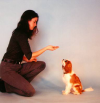
Give every guest a bag of training treats so that your puppy will be inclined to like them from the outset. Show your guests how you use your puppy's dinner kibble to lure/reward train him to come, sit, lie down, and roll over. Ask your puppy to come. Praise him profusely as he approaches and give him a piece of kibble when he arrives. Back up and do it again. Repeat the sequence several times.

Each time the puppy approaches, have him sit. Say, "Puppy, Sit," and slowly move a piece of kibble upwards, from in front of his nose to between his eyes. As the puppy raises his nose to sniff the kibble, he will lower his rear end and sit. If the puppy jumps up, you are holding the food lure too high.

Repeat the procedure with the food closer to the pup's muzzle. When your puppy sits, say, "Good dog," and give him the kibble.

 
Training:  Basic Manners

Pages

Subscribe to Front page feed
Are you a veterinarian? Sign up for the Veterinary Behavior & Training Program – Free on Dunbar Academy