


Error message

User warning: The following module is missing from the file system: recaptcha. For information about how to fix this, see the documentation page. in _drupal_trigger_error_with_delayed_logging() (line 1184 of includes/bootstrap.inc).

Dominance and Dogs: Who is the Boss?

Dogs often act as connectors in society. Upon sharing your life with a dog, you may find yourself talking to more people when you’re out and about at the dog park, cafes, etc, or you may even...

Resolving Dog-Dog Reactivity

FOR A LIMITED TIME Watch the all-new Dunbar Academy Dog-Dog Reactivity webinar for FREE, where Dr. Ian Dunbar explains the common causes of reactivity and how to resolve reactivity using 10 easy and...

All Puppies Deserve a FIRST Chance — an EDUCATION!

Owners and their new puppies are still getting the short end of the stick. Dog problems are invariably blamed on “irresponsible dog owners” BUT they are simply at a loss for what to do, and, no...

Puppies and Shelter Dogs: Two Sides of the Same Coin

I am a dog trainer and I lead a double life. Of sorts. Behaviorally speaking. I am the Director of SIRIUS Puppy Training, a San Francisco Bay Area puppy training school. Our mission is to teach new...

New Free Course – Six Simple Steps to Solve Your Dog's Behavior Problems

We've just published a new FREE course on Dunbar Academy called Six Simple Steps to Solve Your Dog's Behavior Problems. This course is filled with short videos and downloadable documents that provide

The Essential Puppy Training Course is HERE!

We are thrilled to announce the release of our all-new Essential Puppy Training Course. We've been hard at work developing this course for the past year and are extremely excited about it. So to
z_Toy_Retrieve3.preview.png

Kong Cup Challenge

In one of the most exciting and fast-paced games, dogs have just one minute to accumulate as many points as possible by retrieving chewtoys of different point values from an enclosed retrieval area. Light-blue (water) Kongs are valued at 5 points, red Kongs at 3 points and black Kongs 1 point. The handler stands in a two-yard square Handler's Box within a five-yard square penalty box. In order for points to score, the handler must be able to take or pick up the object (with at least one part of their body remaining grounded in the Handler's Box) and place it in a plastic bucket. If the dog brings back a Bonus Kitty (soft toy) the final score is doubled, whereas if the dog’s paw enters or cuts the line of the Penalty Box while he is carrying a Penalty Bone in his jaws, the final score is halved. Retrieving a Kong Biscuit Ball increases the allotted retrieval time by 15 seconds. The dog with the highest score wins.

Training Tips

 
1120_GAMES_Doggy_Dash.jpg

Doggy Dash - Racing Recalls

Pairs of dogs race against each other and the winning dogs go through to the next round. Each dogs is held at the Start Line by a steward who releases the dog as soon as the judge says, “Ready, steady go!” The first dog to sit across the Finish Line wins and goes through to the Second Round. Dogs are disqualified if they leave their racing lane. Winning dogs from the Second Round go through to the Quarter Finals. Eventually, two dogs compete in the Final to determine who is the fastest dog of the competition.

Training Tips

 
1111GAMES_MC_2.png

Musical Chairs

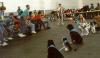
Musical Chairs is a doggy variation of the classic children’s game. Music plays as handlers walk with their dogs off-leash counter-clockwise around a rectangular area. A line of chairs (with alternating chairs facing in opposite direction) runs down the centerline of the rectangle. When the music stops, the handlers instruct their dogs to sit by verbal request and/or hand signal only, (i.e., without touching them), and rush to sit on a vacant chair in the center of the rectangle. Musical chairs is meant to be a non-contact sport; with the exception of two human rear ends making contact when attempting to sit simultaneously on the same seat, physical contact with any dog or other competitors is not allowed.

 
1101_K9_GAMES_logo.png

Ch 8: K9 Games®

— The Ultimate Dog Show —
Over the past few years, television has gone to the dogs! Dogs have become more and more prominent in the media, movies and sitcoms. Puppy dogs have a proven “Ahhhhh!-factor” and are used to advertise numerous products from cars to beer. In England dogs even advertise toilet tissue! Dogs have everything. The time has come for dogs to advertise themselves!

Twenty years ago, I predicted, that dog events (especially Dog Dancing) would become the next big-money TV sport, in much the same way that Figure Skating (skating repetitive figures) has evolved into Ice Dancing. It is just begging to happen.

 
DogBehavior.png

Ch 7: Dog Behavior

Dog behavior is a hugely fascinating yet widely misunderstood topic. All too often, normal play behavior and communication is misinterpreted as aggression and all too often, a myopic “understanding” of dog social behavior is used as an excuse for people to use aggression when training dogs.

 
Training:  Dog Behavior
z_IMG_0598.preview.jpg

Pulling on Leash

By and large, leash-pulling masks the real problem: without a leash you would probably be without a dog. It is indeed a sobering thought to think that most dogs prefer to forge ahead to sniff the grass or other dogs' rear ends than to walk by their owner's side. There are some dogs who simply don't want to walk beside owners who keeping yanking the leash. However, regardless of why your dog pulls, all dogs need to be trained to walk nicely on leash. If not, they are unlikely to be walked at all. Trying to teach a dog to heel using leash prompts and corrections requires a lot of skill and time. And even then, all you have is a well-behaved dog on-leash. Let him off-leash and he's history; you cannot safely take him for off-leash rambles, and you still cannot control him around the house, where he is off-leash all the time.

 
Training:  Pulling on Leash
DuneMadman.jpg

HyperDog!

Puppies are naturally noisy and hyperactive. Puppies are exuberant when greeting, playing, and when expressing friendliness and appeasement. However, adult dogs are noisy and hyperactive because they are untrained and have unintentionally been encouraged to act that way. For example, eagerly jumping puppies are petted by people, who later get angry when the dog jumps up as an adult. The dog's only crime? It grew!

 
Training:  Hyperdog!
135_ClaudePencil2.png

Fighting

Many people have unrealistic expectations about dog-dog social behavior. Dogs are expected to behave perfectly and get along with all other dogs, even though people have difficulty being universally accepting and friendly. However, although people may often disagree, argue, and sometimes resort to pushing and shoving, very few people inflict severe injuries. When tempers flare, extreme physical aggression is strongly inhibited. Really, dogs are not that much different.

Most dogs have frequent disagreements and arguments, and on occasions resort to scrapping noisily, but only extremely rarely does one dog severely harm another. Whereas it is unrealistic to expect dogs never to squabble, it is perfectly realistic to raise and train dogs to never hurt each other when fighting.

 
Training:  Fighting
z_DSC06254.preview.JPG

Fearfulness

Socializing a puppy to people is the easiest and most enjoyable aspect of raising a dog. On a regular and ongoing basis, puppies need to meet, play with, and be handled and trained by a wide variety of people, especially including strangers, men, and children.

Narrow Window of Opportunity

Old dogs can indeed be taught new tricks. An adult dog may learn basic manners and good behavior (where to eliminate, what to chew, and when and for how long to bark) at any time in his life. However, socialization must occur during puppyhood—during the critical period of socialization, which ends when puppies are 12–13 weeks old. Shy and fearful dogs can be substantially rehabilitated, but they will never develop the confidence and social savvy of a well-socialized puppy. They will never become what they could have been.

 
Training:  Fearfulness

Separation Anxiety

Your new puppydog needs lots of attention (companionship, education, and play), but also to be taught how to entertain himself appropriately and how to thoroughly enjoy his time when left at home alone. Otherwise, a social vacuum can be a very lonely place.

 
Training:  Separation Anxiety

Pages

Subscribe to Front page feed
Are you a dog breeder? Sign up for the Dog Breeder Behavior & Training Program