










The Dog Blog

Pages

iStock_000007143876XSmall.jpg

An Oft Overlooked Factor of Canine Longevity

Last week the world was introduced to Chanel, the sweet and wizened Dachshund mix that is celebrating her 21st birthday. It’s quite an accomplishment. She is the world’s oldest living dog and she appears to be in excellent condition.

I know the news is a bit stale and has already been covered, but Chanel has stayed on my mind, and not because of her cute red sweater and matching doggles.

I couldn’t help but notice that in all of the stories about Chanel and what kept her healthy and spry, there was what I think an important omission.  Nobody mentioned Chanel’s behavioral health as part of the reason why she’s still alive today.

 
K9 Dsc_1162.jpg

The K9 GAMES in France – May 2009

It’s very difficult to get back to routine life when you have just spent 3 days at a K9 Games workshop with Ian Dunbar.


I had the idea to bring the event to Toulouse, in the south of France so I could have the pleasure of participating with my dog. But I never imagined that it would be so funny, so exciting and so relaxing!


Since the event we have emails from attendees everyday who say « Thank you to have given us the opportunity to be part of such an event. When does Ian come back? »


These are only games, but oh my, we are training and having fun at the same time and dogs can at last experience their owners having fun in training.
I really do think that the K9 Games should be much more popular all over the world.


Why?

 
dogkids.jpg

Okay for Dogs, but Not Kids?

A Salem, Oregon man made the news when police found out he was using a shock collar on his children. People were outraged to hear that he'd chased his three year old child with the collar, making the child cry, because he thought it was funny.

John Seroczynski, the national sales manager for D.T. Systems, a shock collar manufacturer, said it was not likely that the children were seriously injured.

He was obviously talking about physical injury, as he explained that no shock collar today would burn a person or dog and would not cause any serious physical injury.

I'll give him that, but every fiber of my being will stand firm in the opinion that those children have been seriously injured. Perhaps not physically, but absolutely emotionally. If there was no harm done, why would the father be in custody and why would any of us care?

Seroczynski said the collars are not to be used on humans.

 
Logan_n_Phee.jpg

Chalk One Up to the Underdogs

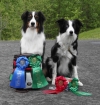
Okay, let's be honest, when it comes to competition obedience, how much of an underdog could a Border Collie and Aussie really be, but believe it or not, in my neck of the woods, the two dogs pictured, Logan and Phoenix, kind of are. Dog sports within the mid-Atlantic area (PA, NJ, VA, MD) is highly competitive. Earning an OTCH (Obedience Trial Championship) has become more and more elusive through the years, and has become limited to trainers who view competition almost as seriously as a job, rather than a part-time hobby. For us part-timers, particularly those of us who use only positive methods and have more of a pet person mentality (those of you involved in dog sports will know exactly what that means), no matter what breed we have, we're definitely considered underdogs. No matter how you train or what methods you use, you never really know what a dog is going to do in the ring.

 
iStock_000006323489XSmall.jpg

Losing It Is Not Impressive (nor effective in the long term)

Yesterday I was at the studio where I workout, focusing on my breathing in a relatively quite environment, when suddenly the peace and my concentration were shattered by deep bellowing screams coming from the street down below.  It was the voice of a woman, an ANGRY woman.

At first I thought it was the beginning of a fight, but soon I realized that I only heard one voice carrying on (and on, and on). I tried to ignore her, but she was loud and the things she was saying were terrible and ugly. Then I heard her demanding someone (or something) to “GET OVER HERE NOW!”  

The chaos continued for several minutes. Eventually it dawned on me. She was talking to a child. Presumably her own. Finally I looked outside because if there is one thing I cannot tolerate (there are actually many, ask my family and friends) it is the abuse of children and animals.

 
TripFetchingTagwithText.jpg

Trip [The Light Fantastic]

While The CDC (Center for Disease Control) has been working double overtime lately as evidenced by the constant stream of H1N1 Virus (nee Swine Flu) discussion, reporting, analyzing, speculating and more, lesser known perhaps is that in late March of this year they released analyzed fall data and disclosed the following fascinating stats:

• 88% of fall related injuries were associated with dogs or one of their pet items such as a toy or bowl.

• 31.3 % resulted from falling or tripping over the dog (versus the overwhelming 66.4 % of cats being tripped over) which included falls from chasing after a dog with obviously poor recall (another one of The Six Things All Dogs Should Know!)

• 21.2 % from being pushed or PULLED by the pet.

• Women were TWO TIMES AS LIKELY to be injured as males. (Hmmmmm)

 
LureWalkBailey.jpg

Leash Aggression

(photo is Bailey - Lure-walking)

Leash Frustration or ‘Leash Aggression’ is a very aggressive-looking reaction to other dogs (or people) when on-leash. This comes from the feeling of frustration at not being able to freely investigate the other dog (or person). It doesn't necessarily mean that he wants to fight, but he does associate the frustrated feeling with the presence of other dogs (or people), so the aggressive behavior is directed at them. With intense frustration, there can be a loss of self control which can increase the likelihood of a bite, even if your dog is not normally aggressive.

 
bart.jpg

Well done to those who take the advice!

Meet Bart, a little collie cross. He lives with two children and he was there first! He doesn't pull on the lead, jump up on people or the kids in the home, steal things or act in any way inappropriately.

Why? Because his owners called for help when he was a new puppy who had arrived in their home at 9 weeks old. They listened and took on board every piece of advice they were given and worked hard to give Bart what he needed.

Today at age 4 Bart has a healthy diet, an appropriate exercise regime, fun things to do that are instinctive to his breed type plus, and most importantly he is a member of their family. When the children arrived Bart was never excluded. He was involved from day 1 with the result that he loves his family and little people plus he knows exactly how to behave around them. His owners give him feedback on everything he gets right with the result that he rarely gets anything wrong!


Hypothyroidism Help

Treating hypothyroidism as a way to improve behavioral health dates back to the 1940s, when psychiatrists first noted this correlation in their human patients.  More recently, Drs. Nicholas Dodman and Linda Aronson, of Tufts Cummings School of Veterinary Medicine (TCSVM) began treating dogs with behavior problems for low, or borderline-low, thyroid levels and noting an improvement in a variety of behavior problems involving fear, anxiety and aggression.    While such reports of behavioral improvement are helpful, more conclusive evidence is necessary to validate the therapeutic efficacy of thyroid replacement therapy in the treatment of canine behavior problems.  To address this need, researchers at TCSVM are currently enrolling dogs that demonstrate owner-directed aggression and have concurrent low or borderline low thyroid levels into an 8-week clinical trial.  

 
DSC00065.JPG

Teaching what you don't want, by teaching what you want!

Often when we think about undertaking some formal training with our pets we usually have a list of things we would like them to stop doing.

These can be:
1. stop Rover from pulling on the leash
2. barking at other dogs
3. chewing up the furniture …

When we then think about how to change these behaviours it often seems natural to think of some way to stop the dog from doing them by using some form of punishment. Although we know that punishment does works to stop certain behaviour if applied properly this is not very easy to do and has side effects. So what if we thought about training our dogs in a slightly different way:

One question we often forget to ask when we think about training our dog is “what would we like him to do?” So instead of the responses mentioned above we would think how would like Rover to:

1. walk on a loose leash
2. sit and look at me as another dog walks by
3. chew on these certain toys


Pages

Subscribe to The Dog Blog
Are you a veterinarian? Sign up for the Veterinary Behavior & Training Program – Free on Dunbar Academy